(Accesswire) New York — C15 offers an electronic Quality Management System (eQMS) platform designed to enhance quality and compliance while minimizing operating costs in the cannabis industry.
While AlphaRoot is more than an insurance broker, specializing in comprehensive risk management solutions tailored to its clients’ needs. Both offerings align closely with the values of each company: risk mitigation and quality management. Just like C15, AlphaRoot is committed solely to serving the cannabis sector.
“We are extremely excited about this very natural partnership. Proper compliance and risk management should have tangible benefits, and now C15 customers and the industry at large can benefit from superior risk ratings and better access to insurance at lower costs.” — Sean Samuel, VP of sales and marketing, C15
“When considering strategic partnerships, we look for alignment in culture, service, and expertise. Above all, we look for partnerships that will have a positive impact on our clients. The collaboration between AlphaRoot and C15 not only meets but exceeds all of our desired characteristics. The combination of C15’s innovative platform, AlphaRoot’s insure-tech platform, and the comprehensive insurance and risk management services that we provide to clients create a natural synergy. This partnership is expected to enhance our clients’ risk profiles as they continue to scale.” — Hunter Baldwin, commercial cannabis risk advisor, AlphaRoot
Advertisement
About C15 Solutions Inc.
C15 delivers a customized eQMS (Electronic Quality Management System) platform exclusively for the cannabis sector to enhance the quality, safety and consistency of cannabis products while lowering operating costs. The company is a leading tech partner to a global customer base of operators, cultivators, processors, manufacturers of cannabis products, and labs. C15 has a proven track record of isolating and reducing the cost of quality for its customers while strictly adhering to all industry jurisdictional regulations.
About AlphaRoot Insurance
AlphaRoot is a full-service insurance brokerage and advisory firm that works exclusively with the cannabis, hemp, CBD, holistic medicine, and psychedelic industries. The company has clients across the entire supply chain, from new licensees to public operators, and extends out to ancillary and capital providers. The AlphaRoot team believes that in order to stay on the vanguard for their clients, an intense focus on the challenges their clients face is a necessity. Ultimately, the AlphaRoot goal is to become a trusted source for insurance and risk management strategy and implementation, fueling their clients’ growth. Visit
Lexaria Bioscience recently received four new patents granted in Canada and the United States
In the U.S., the company received two new hypertension-related patents expected to be of particular importance as the company pursues FDA approval for a Phase 1b study evaluating DehydraTECH(TM)-processed CBD
So far, the company has a robust intellectual property portfolio comprising 34 patents granted worldwide
The strong portfolio gives the company the necessary impetus and peace of mind to pursue multiple large markets, starting with the multi-billion dollar cardiovascular drugs market
The company has conducted five human clinical studies that have provided insights into the potential of DehydraTECH-CBD to reduce blood pressure
Lexaria Bioscience’s (NASDAQ: LEXX) intellectual property (“IP”) rests on a strong foundation of granted patents worldwide, a foundation that was recently strengthened by new patents granted in North America. The company, which is developing its patented DehydraTECH(TM) technology platform with the intention of availing it to the masses as an additional step in the manufacturing or processing of active pharmaceutical ingredients (“APIs”) with better bioavailability and bioabsorption properties, celebrated the receipt of four new patents granted in Canada and the United States (https://cnw.fm/ZYNTt).
In Canada, the company has been granted two new patents, the first for Patent Family #1: Food and Beverage Compositions Infused with Lipophilic Active Agents and Methods of Use Thereof. According to the company, this is the first patent for this Patent Family issued in Canada, but the 18th patent in this family worldwide. The second patent granted falls under the company’s Patent Family #8: Compositions Infused with Nicotine Compounds and Methods of Use Thereof and is the company’s second patent in this Patent Family, following a similar issuance in Australia.
Across the border in the United States, Lexaria received two new hypertension-related patents, both under its Patent Family #21. The first covers Pharmaceutical Compositions and Methods for Treating Hypertension, while the second is for non-pharmaceutical Compositions and Methods for Treating Hypertension. The company expects these two patents to reinforce its commercial opportunities in both pharmaceutical and consumer markets.
The two new hypertension-related patents come at a time when the company is looking to file its Investigational New Drug (“IND”) application seeking approval from the Food and Drug Administration (“FDA”) to commence the formal and registered study HYPER-H23-1, a Phase 1b evaluation of DehydraTECH-CBD for hypertension, later this year. In fact, Lexaria believes these patents “could be of particular importance related to the company’s pursuit of utilizing DehydraTECH-CBD in relation to our expected upcoming FDA IND application.”
Once approved, the FDA-registered IND program will build on positive data from five hypertension-focused human clinical trials, which evidenced lower blood pressure among participants who received DehydraTECH-processed CBD.
The company’s first human study of 2021, HYPER-H21-1, evidenced a reduction in BP across both male and female volunteers, with the drop most pronounced within the first 10-50 minutes after dosing (https://cnw.fm/980Ou). HYPER-H21-2, a 16-person study, evidenced up to a 23% average drop in overnight blood pressure and reduced arterial stiffness (https://cnw.fm/s3CmC), while HYPER-H21-3, also a 16-person study, showed that DehydraTECH-CBD’s use reduced pulmonary artery systolic pressure by about 5 mmHg or 41% overall among male participants (https://cnw.fm/YQxZV).
The company then conducted the HYPER-H21-4 study, its most comprehensive study yet, involving 66 participants. This fifth study evidenced the exceptional safety and tolerability profile of DehydraTECH-CBD, with the formulation resulting in a statistically significant lowering of 24-hour ambulatory blood pressure. The company also observed that the formulation lowered patients’ BP throughout the entire study duration (5 weeks) and that it was effective at lowering the BP among patients who were taking other antihypertensive drugs as well as those who were not taking any such drugs (https://cnw.fm/0tbue). The company has also released additional findings from this study, adding to its list of successes announced in 2023.
So far, on the IP front, for example, the company has received seven new granted patents in the current financial year (2023), which commenced September 1, 2022, six of which have been awarded in calendar 2023. As a result, Lexaria now holds 34 granted patents worldwide. The company has achieved considerable intellectual property protection through this existing patent portfolio, giving it the necessary impetus and peace of mind to pursue multiple large markets, including the cardiovascular drugs market, which is projected to grow at a 3.1% CAGR from $153.6 billion in 2022 to $173.48 billion by 2026 (https://cnw.fm/TcVIq).
NOTE TO INVESTORS: The latest news and updates relating to LEXX are available in the company’s newsroom at https://cnw.fm/LEXX
About CannabisNewsWire
CannabisNewsWire (CNW) is an information service that provides (1) access to our news aggregation and syndication servers, (2) CannabisNewsBreaks that summarize corporate news and information, (3) enhanced press release services, (4) social media distribution and optimization services, and (5) a full array of corporate communication solutions. As a multifaceted financial news and content distribution company with an extensive team of contributing journalists and writers, CNW is uniquely positioned to best serve private and public companies that desire to reach a wide audience of investors, consumers, journalists and the general public. CNW has an ever-growing distribution network of more than 5,000 key syndication outlets across the country. By cutting through the overload of information in today’s market, CNW brings its clients unparalleled visibility, recognition and brand awareness. CNW is where news, content and information converge.
To receive instant SMS alerts, text CANNABIS to 21000 (U.S. Mobile Phones Only)
Please see full terms of use and disclaimers on the CannabisNewsWire website applicable to all content provided by CNW, wherever published or re-published: http://CNW.fm/Disclaimer
Do you have questions or are you interested in working with CNW? Ask our Editor
(Globe Newswire) Chatham, Ont., Tel-Aviv, Israel — Atlas Global Brands Inc. announced today that further to the company’s news release dated June 2, 2023, Ernst & Young Inc. has been appointed as receiver and manager over certain current and future assets of Atlas Biotechnologies Inc., a direct wholly-owned subsidiary of the company, and Atlas Growers Ltd., together with Atlas Biotechnologies, an indirect wholly-owned subsidiary of the company, under the Bankruptcy and Insolvency Act (Canada) and the Personal Property Security Act (Alberta).
The Atlas subsidiaries’ senior lender, the Agriculture Financial Services Corporation (AFSC), obtained the receivership order from the Court of King’s Bench of Alberta with the consent of the Atlas subsidiaries. The order follows on the company’s decision to cease operations at its facility in Gunn, Alta. and liquidate the assets of the Atlas subsidiaries in an orderly manner as it focuses on cost reductions, savings and production efficiencies across its operations and the cannabis value chain.
As would be expected in the circumstances, the AFSC has also filed a statement of claim against the company with the court in connection with the enforcement of an existing $1.4 million limited parental guarantee of the company in respect of the indebtedness of ABL to the AFSC. The company and the AFSC are in discussions concerning payment plan of the parental guarantee in the event the proceeds from the liquidation of the Atlas subsidiaries’ assets are not sufficient to satisfy amounts due to the AFSC.
Soma is one of the most curious puzzles faced by ethnobotanical scholars and researchers. Throughout history, its mystery has fascinated many authors in multiple fields of investigation, from mystical to scientific. Is it a deity itself? Is it a plant? A state of mind? Let’s make some order to figure out why it is called the food of the Gods, and why it is such a particular product of extraction.
Actor Populations
Around 3000 b.C. India looked really different from now. Many cultures and civilizations were blooming and some of them colliding led to the evolution of others. During the Bronze Age the Indian peninsula was inhabited by the Dravidas. They penetrated from the northwest and over time took place the “Indus Valley Civilisation” developing writing, urbanization and agriculture as well. Their cults were archaic, but not so obscure to us: they venerated the Mother Goddess, God Shiva, sacred trees, animals like cow and cobra, phallic and sexual symbols (as a continuation of the species) and the most important religion was Jainism. [1]
The Dravidas around 2000 b.C. met the Aryans, they came from the northwest too, but they had a very long history of migration. They were warriors, fighters, grain growers, their language was Indo-European, the Vedic tongue. Those people came from the Eurasian steppe, more precisely from the sites of the Jamna Culture (“pit grave culture”, Russian/Ukrainian); those nomads collided with the Samus peoples, living from Siberia to Scandinavia, they had different and more mystical traditions.
Shamanic Roots
The Jamna peoples had a weaker tradition than the “Russian” one, in fact their strength was not only in the body but also in the mind. It is known that those people were animistic-shamanic and used to take psychoactive or psychotropic substances to get in touch with nature and its events.
There is no reliable data on this and the only knowledge on how to use and prepare these psychedelic mixtures was only handed down orally. [2] The hypothesis concerns Amanitamuscaria L., which induces powerful visual and auditory hallucinations. It will eventually be the most popular candidate for the Soma mystery.
From the spread of Jamna culture peoples migrated to Eastern Europe-Central Asia to become Sintashtaculture (2100-1800 b.C.), and later to Central Asia-South Siberia became Andronovoculture (1800-1200 b.C.).
At the very beginning of the Iron Age, they began to settle what is now known as the Archaeological Complex Bactriano-Margiano (ACBM) which is today’s northern Afghanistan. Later in 1800-1500 b.C. They descended in the north of India (today Hindukush), where the Dravidas, vulnerable due to climatic changes, let their cultures mix into one, the Indo-Aryan.
From that moment starts the Vedic Period, with the development of all the traditions that led to what is today the Indian Pantheon and all the parables and metaphors that characterize the Hinduism. [1]
Merging together these cultures maintained the worship of Dravidas for Nature, the mystical divination rites of the Samus and the funeral sacrifices of the Sintashta.
Sacred Texts
Veda is the Sanskrit word for knowledge, in fact the Veda literature is made of the oldest scriptures of Hinduism. [3]
To date these texts have been translated from Sanskrit to Hindi, from Hindi to French and from French to English. Some might say that the deep meaning may have been lost, but if it is something that is produced by humanity, it can be understood and studied to get how it can be passed down and how beliefs and practices of the past may have been abandoned or preserved, in part modified, until today. In fact, the tradition of the Soma has been lost, the only references are in the sacred texts, but the ultimate knowledge of what it was lost traces in the 6th century b.C.
The hypothetical plant grew on the mountains, but under the circumstances there could be no ceremony attending the gathering of the sacred Soma, because the priests seemed to hide its identity and power. [4]
Soma and its Botanical Characteristics
The botanical characteristics of Soma are not very detailed, but with the aim of identifying a plant or its possible substitutes of the time it was deduced from the text that “its shape resembles that of a stem, a stocky branch”. Could it be only a deity? Or maybe also a metaphor for a real thing?
One might wonder how they transformed themselves from archaic practices into mantras, prayers and deities of Hinduism, but also whether or not there was the use of natural products to encourage all this sacred oral production i.e., Cannabis sativa L., Amanita muscaria L., Banisteriopsiscaapi (Spruce ex Griseb.) C.V. Morton, Peganum harmala L.
All of these examples have characteristics in common with those described for the Soma, mostly those relating to the effects like loquacity and the deep sense of peace after luminous and visual hallucinations. Only Amanita muscaria L. seems to lend itself to the extraction process which we will see later.
Some Scholars highlighted that the luminous effects and visions could also appear “during fleeting states of dissociation, daydreaming, hypnagogic states, isolation, sensory deprivation, or other situations of stress”. Another probable identity has been detected: Ephedra sinica L. whose main active ingredient is ephedrine. The individual who takes ephedrine, due to sympathetic hyperactivity presents inappetence, insomnia, little warning, lack of sense of tiredness. This particular condition causes sleepless nights, which if dedicated to meditation can lead to visionary effects without the use of real hallucinogens. [5] In this case the importance of understanding the real identity of Soma is glaring, most of it for the significance of the words of the Rigveda hymns.
Looking for Soma
The Rigveda is made of 1028 hymns, of which 114 about Soma.
Soma is represented as a God, a Plant (or a mushroom) and the Juice of a plant to reach the contact with gods.
The official translations like the ones of Wasson, describe Soma “as a tangible, visible thing, its inebriating juice to be ingested by the human organism in the course of the ritual, a God come down and manifesting himself to the Aryans, Soma played a singular role in the Vedic pantheon. The poets never tire of stressing Soma’s sensuous appeal. In appearance it was brilliant, reminding them of the Sun, of Fire, of the rays of the Sun, of the round bowl of the heavenly firmament, “the back of the sky”. [4]
As it seems, Soma is hallucinatory meditation, but always reminiscent of something like food. In those times medicine and food were barely the same concept. [2]
Soma as Predecessor of Extraction Industry
The Soma extraction wasdone through the “pressure between two stones“. The “juice came out of an amber, yellow colour, like gold” was strained into a bowl, called dishaana.
“Once expressed, the juice of the plant must pass through a sieve, where it is purified”.
This sieve is made in sheep’s wool, from there the soma flows into wooden vases, in the hymns, dru. The poet-priests mixed it with milk or sugary drinks to improve its flavour. Soma “was collected in the mountains” and in “periods when it was scarce it was dried and stored in order to be rehydrated again when needed”. [6]
Here we read a clear reference to the fact that the juice was expressed starting from a skilfully manipulated vegetable matrix. There isn’t evidence that someone except priests drank Soma and the maximum dose was three times per day: who drinks Soma is the “not dead”, someone who can bear its effects and bring the word of the divine back to men. [6]
In the Bower Manuscript the scholars found out two recipes, Amrita, including more than a hundred plants, that were extracted in oil or in clarified butter, some of them were Ephedra, or Peganum species, but nowadays it’s almost impossible to be sure if the effect was related to one only plant, or to the massive number of active principles extracted together. [2]
The Food of the God
When the Soma is born and becomes a plant, the transmutation of the God from the divine to the physical plane takes place: in drinking the juice man becomes able to know the god and Indra enters inside him, drinking himself the Soma juice, to give man enlightenment. [7]
College athletes may soon earn a reprieve against anti-cannabis policies that prevent athletes from consuming cannabis and penalize those who do. Much like the federal government, most sports organizations have banned cannabis consumption among their respective athletes. However, the NCAA Committee on Competitive Safeguards and Medical Aspects of Sports is urging the National Collegiate Athletic Association to remove marijuana from its drug testing protocols and list of banned substances.
After decades of federal criminalization and millions of lives changed, a wave of cannabis reform is sweeping across America, leaving dozens of states with either medical or recreational cannabis markets, sometimes both. America’s state-legal cannabis industry is now one of the fastest-growing sectors in the country, responsible for employing hundreds of thousands of people and providing states with billions of dollars in tax revenue.
However, marijuana is still controlled at the federal level and is classified as a Schedule I drug with no medical applications. This is despite the fact that numerous studies have found cannabis to be effective against several medical conditions and more than 30 states allow medical marijuana use. This means that certain classes of employees, including professional athletes, can be penalized for using cannabis as per state regulations. For example, American sprinter Sha’Carri Richardson recently lost her spot in the Tokyo Olympics after testing positive for cannabis before the race.
If the NCAA panel is successful, drug testing will be limited to substances that can enhance performance, which cannabis cannot. The NCAA panel said in a recent statement that its committee would collect input on the move to remove cannabis from the list of banned substances over the summer before taking action in the fall.
At a meeting in mid-June, the committee requested that the NCAA pause cannabis testing among athletes until the matter is finally put to rest. According to committee members, the association should approach cannabis as it did alcohol and eliminate punitive measures for cannabis use in exchange for education on the health risks posed by using the drug.
If the NCAA agrees, this wouldn’t be the first time it has stepped back on some of its punitive cannabis policies. In 2022, the association increased the maximum threshold of THC, the main psychoactive agent in cannabis, and recommended a restructuring of the penalty structure for athletes who fail THC tests via the Committee on Competitive Safeguards and Medical Aspects of Sports.
Companies such as IGC Pharma Inc. (NYSE American: IGC), which are focused on developing FDA-approved therapeutic formulations from marijuana compounds, are likely to help athletes and other groups of patients benefit from the medical effects of marijuana without taking the risk of running afoul of any existing laws, whether federal or state level restrictions.
NOTE TO INVESTORS: The latest news and updates relating to IGC Pharma Inc. (NYSE American: IGC) are available in the company’s newsroom at https://cnw.fm/IGC
About CNW420
CNW420 spotlights the latest developments in the rapidly evolving cannabis industry through the release of two informative articles each business day. Our concise, informative content serves as a gateway for investors interested in the legalized cannabis sector and provides updates on how regulatory developments may impact financial markets. Articles are released each business day at 4:20 a.m. and 4:20 p.m. Eastern – our tribute to the time synonymous with cannabis culture. If marijuana and the burgeoning industry surrounding it are on your radar, CNW420 is for you! Check back daily to stay up-to-date on the latest milestones in the fast -changing world of cannabis.
To receive instant SMS alerts, text CANNABIS to 21000 (U.S. Mobile Phones Only)
Please see full terms of use and disclaimers on the CannabisNewsWire website applicable to all content provided by CNW420, wherever published or re-published: http://CNW.fm/Disclaimer
Do you have questions or are you interested in working with CNW420? Ask our Editor
Canadian cannabis producers work under the same federal laws, but when it comes to provincial jurisdictions, each has a different approach. Some provinces have programs to support local producers, whereas others essentially ignore the industry; some are more protectionist, whereas others have equal access for all providers—no matter their location.
“The Société québécoise du cannabis, or SQDC, is very protectionist,” says Cartel Cutler, Managing Partner at Higher Peaks Agency, a Toronto-based sales and marketing organization that represents over 20 different brands. “With the SQDC, there is no chance of getting a listing unless it comes from a local provider. The SQDC will take product from out of province, but it has to be distributed through an LP in Quebec.”
Quebec is something of an outlier in that other provinces and territories in Canada are nowhere near as protective of local producers. Most, in fact, make little distinction. That said, some have policies that are specifically designed to help the local cannabis industry, such as British Columbia.
“The BC Liquor Distribution Branch (LDB) is committed to supporting local, BC-based producers,” says Kate Bilney, Senior Manager, Communications and Stakeholder Relations at the BC LDB. “The province has implemented two key programs aimed at supporting local producers in the province: the direct delivery program, and the BC Indigenous Cannabis Product (BCICP) program.”
The LDB’s direct delivery program was launched in August 2022, and continues to grow. It helps small-scale producers in BC to enter the market, authorizing them to deliver directly to retailers.
The BCICP, launched in January 2022, aims to highlight cannabis products from BC-based Indigenous producers, and to help consumers identify Indigenous products. The program is available to cannabis producers with at least 51 percent Indigenous ownership and facilities in British Columbia.
Home Grown Pride
The Ontario Cannabis Store (OCS) – the largest centralized wholesaler of legal cannabis in the world – also has programs that support local producers.
“The ‘Ontario-Grown’ curated product list, exclusive to OCS.ca, invites adult consumers to browse and shop a variety of cannabis products grown locally in Ontario,” says Mike Hajmasy, Senior Communications Advisor, Strategic Communications at the OCS. “As well, The OCS’s ‘Craft Cannabis’ designation and product list invites adult consumers to browse and shop craft-designated cannabis products, which are sourced from LPs in Ontario and across the country.”
The OCS, which has a catalogue of 3,000 unique cannabis products and distributes to more than 1,600 brick-and-mortar retail stores across the province, also has a farmgate program to help out local LPs.
“LPs can sell cannabis products to the OCS for sale at the farmgate store without first having to ship that product to the OCS Distribution Centre,” says Hajmasy. “As a result, farmgate stores located at production facilities across Ontario can make their products available directly to adult consumers. There are currently five farmgate stores operating in Ontario.”
Overall, getting products into the OCS is a complex process. When it comes to smaller and local producers, the province’s flowthrough program, which allows retailers to order select products that aren’t stocked by the OCS warehouse, should help with market access.
“The OCS is trying to get to a better place by expanding the flowthrough program,” says Cutler. “Conceptually, it’s a great idea, as it gets products into people’s hands faster. Ultimately, it could replace the product call process, which would be great because right now it’s an onerous and drawn-out process.”
Alberta, which has received some criticism for not supporting local LPs, is making strides in this area, given that 35 of the 147 LPs that the Alberta Gaming, Liquor and Cannabis (AGLC) works with are Alberta-based, and that many of the AGLC’s product listings are made up of Alberta-produced products.
Meanwhile, Saskatchewan and Manitoba, which don’t have a formal product call process or specific programs for local LPs, nonetheless receive praise for their ease of doing business. In Saskatchewan, all LPs ship to one of the approved distributors or directly to retailers. In Manitoba, the Manitoba Liquor & Lotteries Corp (MLLC) coordinates with LPs for direct-to-retail delivery.
“My favourite model is by far Saskatchewan,” says Cutler. “Manitoba as well, because it is easy to get listings and to bring all of the products that you’d like to market.”
Promoting the industry
The cannabis industry in Canada is still dealing with stigma, which some observers claim has resulted in a reluctance to support the sector and indifference to the need for tax reform. At the provincial level, many jurisdictions have been reluctant to promote the industry in the same manner as local wine or craft beer.
“There should be a break for small, local producers, but it has to come at the provincial level,” says Gord Nichol, owner and president of North 40 Cannabis in Nipawin, Saskatchewan. “For example, small craft beer producers in Saskatchewan have successfully lobbied for reduced excise tax. If we were to cut a similar deal for micros, it would really make a difference.”
Nichol is one of the largest employers in his rural municipality, and pays his workers 80% above the living wage. He argues that a break on the excise tax would make a big difference.
“If significant tax breaks were available, we could double our economic output,” he says. “And all of that would go right back into the economy. Sadly, there’s little political interest to do that, perhaps because we are small, or due to ignorance or stigma.”
There are some examples of provinces taking bolder approaches, which suggests that stigma can be overcome. Usually, these programs are promotional, such as in Nova Scotia.
“The best thing about Nova Scotia is the emphasis placed on highlighting local products and producers,” says Cutler. “The Nova Scotia Liquor Corporation (NSLC) stores have dedicated space and signage promoting the ‘Buy Local’ movement that continues to increase in popularity and demand by customers.”
In Ontario, the OCS also helps out with marketing and with sponsorships and grants at industry events. For example, OCS has a new series of written and video spotlights that showcase Ontario-based LPs. There are also ongoing efforts to support grant programs by event organizers that provide Ontario LPs (and retail stores) with access and visibility at industry events.
Clearly, some steps are being taken to support the industry, though cannabis in Canada still doesn’t receive anywhere near the attention or practical support, that is common practice for other economic sectors, with stigma and ignorance being the most likely reasons. Nonetheless, cannabis industry sales continue to increase as production space and headcount plateau, which suggests that now might be a good time for provinces to revisit their policies and find innovative and practical ways to help local producers compete.
A new report from US-based Headset looks at the evolution of the legal cannabis market over the four and a half years of legalization.
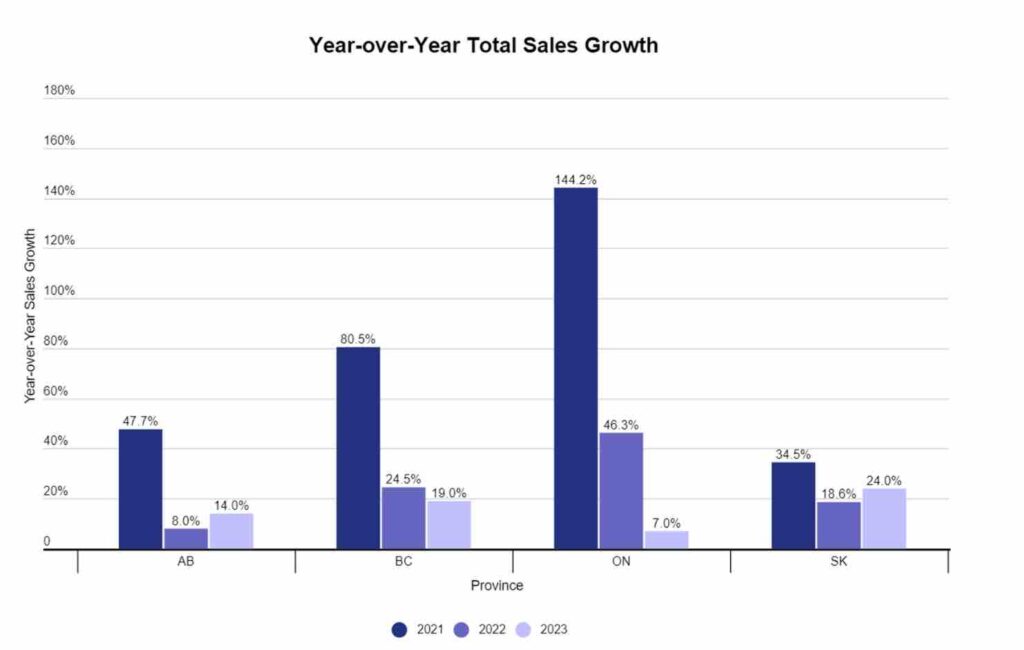
The report shows that while sales continue to grow as demand for legal cannabis increases, that growth is slowing considerably compared with the first few years of legalization: while sales increased by nearly 90 percent from 2020-2021, that number dropped to just under 12 percent for sales from May 2020 to May 2023.
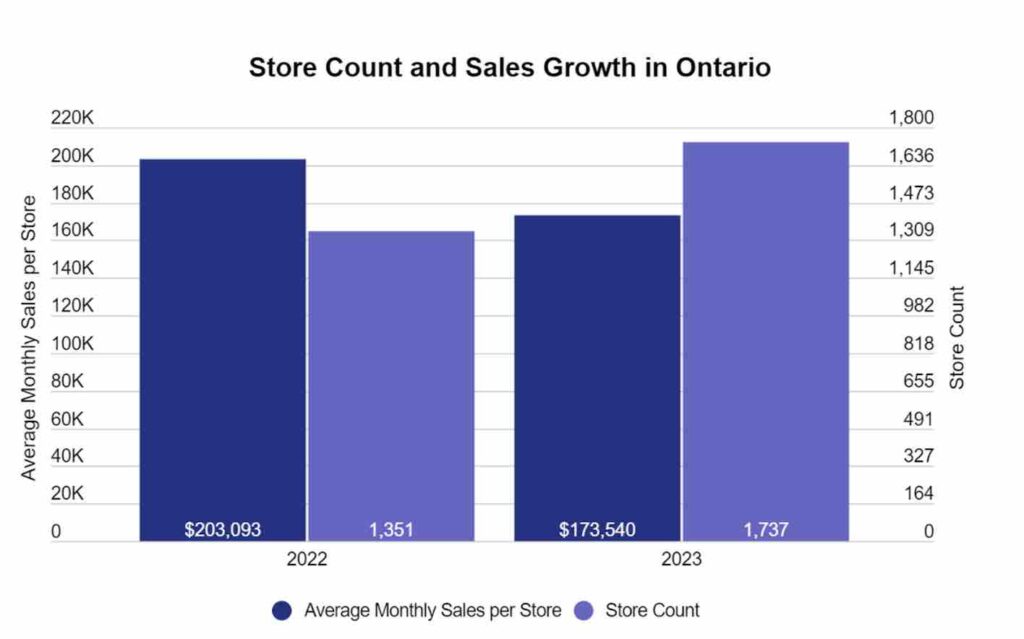
As other recent reports have shown, this decline in market growth correlates with a decline in new stores, as well as existing stores competing for a smaller portion of the market. One example provided by Headset shows that from 2022 to 2023, the average monthly total sales per store in Ontario dropped about 13 percent from around $203k to $177k.
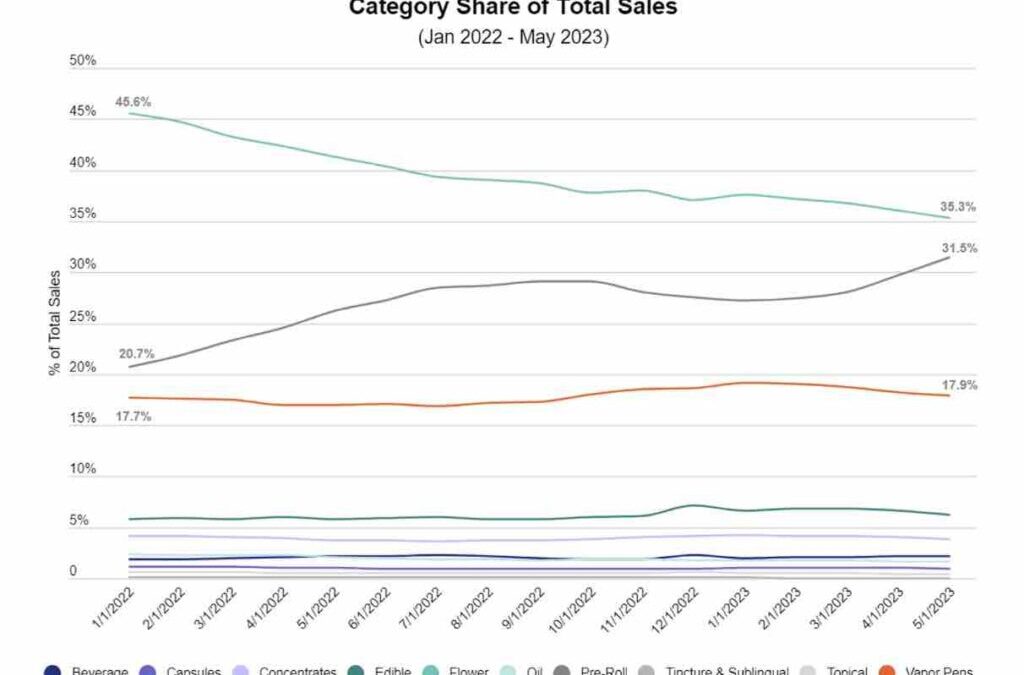
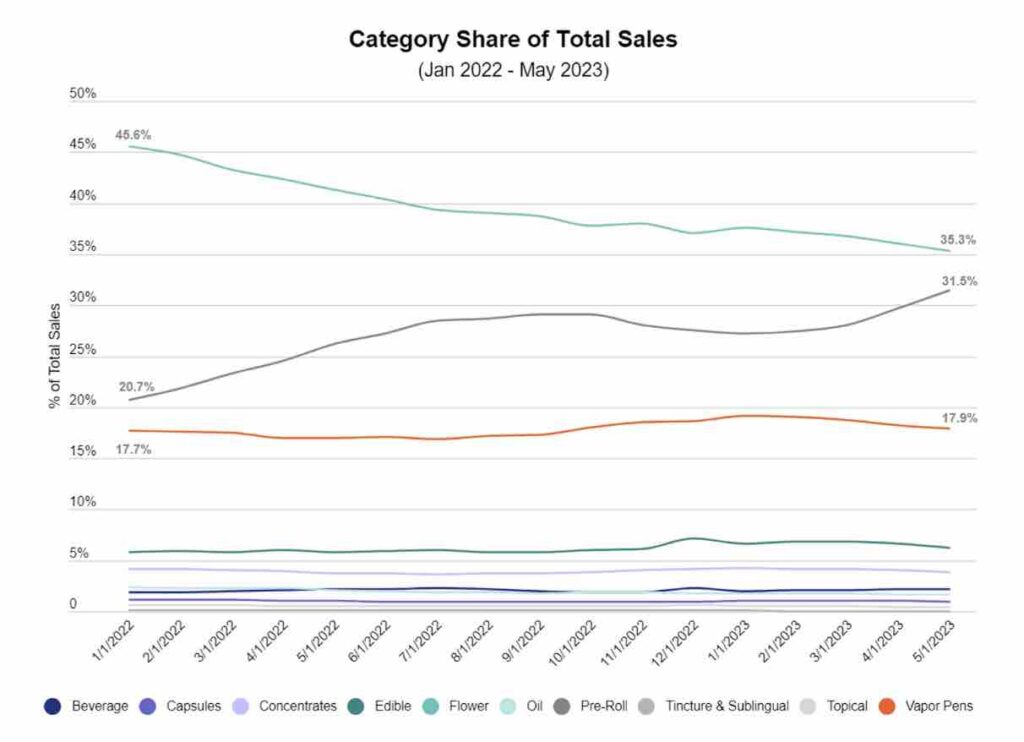
Headset’s data also shows the trend of flower’s dominant market share taking a small hit with the growth in pre-rolls and cannabis extracts, especially vape pens and infused pre-rolls. Cannabis flower sales decreased by just under 16 percent in the last year, while sales of pre-rolls increased by more than 23 percent in the same time period.
Chart via Headset
Cannabis brands also continue to grow, with an increase of 369% between 2020-2023, which has led to a smaller market share for each of these brands, pointing to greater market segmentation. For example, Headset reports that in 2020, the top 21 percent of cannabis brands in Canada captured 80 percent of total sales. In 2023, the top 12 percent captured that same amount.
Prices for most cannabis products have been declining since the beginning of legalization as supply steadily surpasses demand. Prices for cannabis flower, which have dropped more than 100 percent from highs in the first year of legalization, have seen the price per gram beginning to level out since the start of 2022.
Non-inhalable (“edible”) extracts, which made a big splash in 2022 following the launch of several brands, were connected to a more than 25 percent decrease in the price of non-inhalables in 2022. Those products were discontinued by Health Canada in 2023, with the final date of allowed sales being May 31.
Headset gets its data from real-time sales reporting by cannabis retailers using the agency’s services. Figures come from retailers in BC, Alberta, Saskatchewan, and Ontario and begin in September 2019.
Self-defense comes in many forms, but all defense of self begins and ends with dissent, non-compliance, disobedience, saying no to any and all rule, and never allowing aggression against mind and body; mental or physical. Without dissent, defense is not possible, because when voluntary compliance is the prevailing behavior, whether sought, desired, or not, all defense mechanisms are effectively disarmed. In other words, silence in the face of injustice, immorality, terror, or tyranny, creates a condition of weakness, submission, and irresponsibility, which are all the fodder of indifference. When you say nothing, when you do not say no, when you take no action against evil, you commit evil. By not speaking out, and by not responding, you have spoken loudly, and openly committed an act of cowardice. The ultimate blame lies not just with the aggressor in this circumstance, but also equally with he who hides and remains silent.
In “Beyond Good and Evil,” Friedrich Nietzsche wrote: “He who fights with monsters should be careful lest he thereby become a monster. And if thou gaze into an abyss, the abyss will also gaze into thee.” This is an accurate description of the phenomenon of becoming what one lives, so if you live in a state of indifference, ignoring the evil around you, accepting it in order to avoid conflict and responsibility, you become the evil you have chosen to ignore. The dark abyss in this circumstance, is created by your own inaction against it.
What we face as a society, is the most tremendous threat ever perceived or active in the history of mankind. Do you scoff at this seemingly ‘bold’ pronouncement? If so, you are already fooled, and a major contributor to the vast problems rampant in our world today. Instead of the State just singularly seeking war, the continuance of the bogus Federal Reserve System, isolated government corruption, communism, fascism, or any broad-based totalitarian assault on certain segments of society, we are all being bombarded from a thousand different directions at once with all these atrocities and many more, including attacks on our freedom and sovereignty, on our minds and bodies, and on every aspect of our being. Due to the colossal advances in technology, which in many more ways than not are being used against us in order to build a literal transhuman world run by technocratic means, we are facing what could be considered a technological Armageddon, where all control over humanity will be isolated in the hands of the most powerful few. To accept this, to treat it as normal or eminent, is a most fatal error, and one that could determine our fate in perpetuity.
When humanity ceases to exist in any natural form, when male and female become one, when transhumanism and mind control are inescapable realities, when perversion is commonly accepted, the presence of life that we have all known to be magical and a wonder, will have disappeared. The world being designed is not a world of love, hope, and dreams, it is a nightmare of horror, and those pursuing this downfall of man have already lost all human characteristics. They are monsters, so we must fight and defeat them without becoming monsters ourselves.
There is a reason that the children, beginning in infancy, are targeted by State indoctrination, drugs, chemicals, bioweapon injections masquerading as ‘vaccines,’ insane propaganda, distraction, gross perversion, and are pulled away from family mentally and physically throughout their lives. This, in and of itself, if allowed to continue, will guarantee mind destruction of multiple future generations, and that will secure a fully dumbed-down, compliant, and obedient proletariat mass in the future. At that point, total control by the technocrats over humanity will have been achieved.
While technology has the capability to accomplish many great things, in the hands of these monsters who seek universal control, it can also be used to destroy us. Many refer to this technological phenomenon as ‘artificial intelligence,’ (AI) but there is no such thing. This false terminology is being used against us, as machines are not intelligent, they are programmed by intelligence, or so it is believed. When man becomes a machine, real intelligence ends, and a programmed society of slaves is the result. AI is ‘defined’ as “perceiving, synthesizing, and inferring information–demonstrated by computers, as opposed to intelligence displayed by humans or other animals.” Intelligence is defined as the ability to learn, reason, and understand, so honest intelligence cannot be artificial, and machines are still machines. The transhuman digitization of man will mean the end of all traditional life as we know it.
The bulk of this society, has already succumbed to a digital world, and relies on what is falsely labeled ‘social media’ as parent, family, and friend, disregarding the natural state of personal communication, love, companionship, debate, and the grandeur of nature. At this point, the future is not owned by you, but is owned by your masters. All privacy has disappeared, and most all private and financial transactions are captured and data-based. Every aspect of life is now tracked, traced, used, surveilled, restricted, censored, taxed, and every activity imaginable requires licensure (paid permission slip) by the State. You are already a slave, whether you realize it or not.
The plot continues to thicken, as centrally-controlled digital currencies (CBDCs) are being rolled out around the world, which will allow for most every individual to be fully contained and regulated. This will lead to mass restrictions as to what you are allowed to do, where you may travel – if at all, what food you must eat, what medical care you may or may not receive, what State stipend you will be allotted, how much energy you will be permitted to use, and on, and on. Everything in your existence will depend on behavior modification; in other words, do as you are instructed by the State technocratic rulers, or lose everything, as your entire life will be technologically sanctioned.
It is imperative to understand that everything you think you know about technology, and technological advances, is likely at a minimum, 20 years behind. Every so-called new discovery and new technology recognized as such, are not new at all. What the military has now, and is working on today, is unknown to most all except the very few at the top of the pyramid of power. To understand and grasp this concept, should strike fear in the hearts of man. The internet, and therefore, the internet of things, was not discovered and implemented by some computer geek, but was designed and created by the military through the “Defense Advanced Research Projects Agency.” (DARPA) Getting to this terroristic time in our history was no accident, and was intentionally planned long ago. We have little time left to stop this totalitarian hell that has been created in order to destroy what we know as the human race.
Will you continue to sit on the sideline, keeping your eyes closed, your ears covered, and your mouth shut, or will you stand up and defend your freedom and life, and that of your family? The only solution, as I have often said, is through active dissent. Say no to the State, disobey, do not comply with any tyrannical order, and do so as individuals en masse. No one can do this for you, but it can and should be done by many independent freedom-minded individuals. Asking someone else for a solution for the masses as a collective, is worthless, and exposes apathy at a level that if practiced by the herd as it has been for so long, the end of humanity will surely be our destiny.
“Has there ever been a society which has died of dissent? Several have died of conformity in our lifetime.”
Las Vegas, a city that derives a significant portion of its annual revenue from tourism, is one of the many regions looking to tap into cannabis consumption lounges. However, it seems that industry stakeholders and consumers will have to wait a little longer before the city officially launches the consumption lounges.
More than a decade after America’s recreational cannabis industry started taking shape, the public consumption lounge segment has failed to make much headway.
Cannabis reform was always a controversial topic, and even though dozens of states now have either medical or recreational markets, cannabis still doesn’t enjoy 100% support. It is illegal at the federal level, and many local governments and municipalities still don’t allow cannabis-related trade within their spheres of influence.
Even so, stakeholders in several states are working to launch consumption lounges and corner a segment that could prove to be quite lucrative: cannabis tourism. It is becoming increasingly common for Americans in states without legal recreational cannabis markets to travel to states that allow adult marijuana use to indulge in the drug.
However, with most states banning public consumption of cannabis, these “cannabis tourists” often have no way of consuming cannabis unless they are friendly with a resident who could host them at their home.
Efforts to open cannabis consumption lounges in Nevada have been held back for months by limited funding, administrative hurdles, and evolving government regulations on smoke ventilation. Industry experts fear that these and other factors may hinder the launch of the marijuana consumption lounge segment to such a degree that only a few lounges may be open across the entire city by the end of the year.
Factors such as Nevada’s policies on indoor air quality coupled with the immense costs (up to hundreds of thousands of dollars) associated with installing and servicing approved air ventilation systems will likely lock out a large chunk of potential entrepreneurs. These costs would also make it borderline impossible for social equity licensees to gain a foothold in the market as they often come from economically underprivileged areas.
At the moment, the entire state of Nevada has just one legal consumption lounge; the site is located on tribal land and operated by the Las Vegas Paiute Tribe.
Fortunately, it seems that regulators are willing to find a compromise on air quality regulations. According to Nevada Cannabis Compliance Board (CCB) Executive Director Tyler Klimas, state regulators know they will have to tweak regulations to allow the launch of a successful consumption lounge program.
This delay to open consumption lounges doesn’t only affect companies that directly deal with the plant. Ancillary entities such as Advanced Container Technologies Inc. (OTC: ACTX) could also lose out on business since the boom in consumption would have triggered demand for extra cultivation equipment.
NOTE TO INVESTORS: The latest news and updates relating to Advanced Container Technologies Inc. (OTC: ACTX) are available in the company’s newsroom at https://cnw.fm/ACTX
About CNW420
CNW420 spotlights the latest developments in the rapidly evolving cannabis industry through the release of two informative articles each business day. Our concise, informative content serves as a gateway for investors interested in the legalized cannabis sector and provides updates on how regulatory developments may impact financial markets. Articles are released each business day at 4:20 a.m. and 4:20 p.m. Eastern – our tribute to the time synonymous with cannabis culture. If marijuana and the burgeoning industry surrounding it are on your radar, CNW420 is for you! Check back daily to stay up-to-date on the latest milestones in the fast -changing world of cannabis.
To receive instant SMS alerts, text CANNABIS to 21000 (U.S. Mobile Phones Only)
Please see full terms of use and disclaimers on the CannabisNewsWire website applicable to all content provided by CNW420, wherever published or re-published: http://CNW.fm/Disclaimer
Do you have questions or are you interested in working with CNW420? Ask our Editor
A group of four children that recently went missing in the Amazon forest after a plane crash may owe their rescue to ayahuasca. Some people believe ayahuasca played a role in an almost-divine act of intervention that saw the indigenous volunteers and Colombian army scour the expansive rainforest in a race against time to save the missing children.
Ayahuasca is a plant-based psychedelic brew made from hallucinogenic ingredients such as N, N-dimethyltryptamine (DMT). Originating and primarily consumed in Southern America, ayahuasca is said to have neuroprotective, memory-boosting, anti-inflammatory properties. Some studies have also found that the psychedelic can increase mindfulness, boost psychological well-being and improve emotional regulation.
As with several other psychedelics, ayahuasca has been subject to increased media and public attention in recent years due to claims of its potential medical benefits. Some of the earliest psychedelic researchers were particularly interested in how hallucinogens could cause paranormal states of consciousness in users, which reportedly granted some users precognition or telepathic abilities.
Recently, a small plane carrying six passengers crashed in the Amazon jungle in Colombia; four children survived the crash while their mother and the pilot died. With the Amazon’s famous reputation as a deadly jungle flush with predators, it was a race against time to save the young children, aged 11 months to 13 years.
An estimated 50 members of the Colombian Army teamed up with local indigenous volunteers to find the children, finally locating them after 40 days. Although luck, the children’s resourcefulness and the relentless efforts of the rescue team undoubtedly played a role in the daring rescue, some of the volunteers also believe ayahuasca helped the rescue.
Elder José Rubio, one of the locals who aided the rescue efforts, says team members took ayahuasca after 39 days of unsuccessful searching. Rubio took some of the potent psychedelic brew on the 40th day of the search and spent several hours in a psychedelic state before informing the men that they would find the four missing children that day.
It wasn’t long before one of the soldiers learned that a rescue dog had spotted the children some miles from the crash site, finally ending the monthlong search. The children’s father, who took ayahuasca but did not have any visions, believes the drug contributed to his children’s rescue.
The four children were transported to a military hospital in Bogota to recover from their 40-day ordeal.
While this claim that ayahuasca possibly aided the rescue effort may be hard to prove, psychedelics startups such as Field Trip Health Ltd. (OTC: FTHWF) (TSX: FTHW) are engaged in R&D efforts that can provide verifiable clinical study results about the therapeutic effects that these substances can bestow upon their users. From such findings, medicines are likely to be developed for use by patients in need of such treatments.
About PsychedelicNewsWire
PsychedelicNewsWire (PNW) is a specialized content distribution company that (1) aggregates and distributes news and information on the latest developments in all aspects and advances of psychedelics and their use, (2) creates PsychedelicNewsBreaks designed to quickly update investors on important industry news, (3) leverages a team of expert editors to enhance press releases for maximum impact, (4) assists companies with the management and optimization of social media across a range of platforms, and (5) delivers unparalleled corporate communication solutions. PNW stays abreast of the latest information and has established a reputation as the go to source for coverage of psychedelics, therapeutics and emerging market opportunities. Our team of seasoned journalists has a proven track record of helping both public and private companies gain traction with a wide audience of investors, consumers, media outlets and the general public by leveraging our expansive dissemination network of more than 5,000 key syndication outlets. PNW is committed to delivering improved visibility and brand recognition to companies operating in the emerging markets of psychedelics.
To receive instant SMS alerts, text “Groovy” to 844-397-5787 (U.S. Mobile Phones Only)
Please see full terms of use and disclaimers on the PsychedelicNewsWire website applicable to all content provided by PNW, wherever published or re-published: https://www.psychedelicnewswire.com/Disclaimer
Do you have questions or are you interested in working with PNW? Ask our Editor










Recent Comments