A combined study by the University of Colombia and Michigan has revealed an increase in non-LSD psychedelic use by young adult Americans. The poll found that the number of young adults aged 19–30 who use psychedelics other than LSD in the past 12 months doubled from 2018 to 2021.
The study indicated that 3.4% of young adults had used non-LSD psychedelics in 2018 while 6.6% of adults in the same age group had used non-LSD hallucinogens in the past 12 months. Megan Patrick, a research professor from the Survey Research Center at U-M’s Institute for Social Research, coprincipal investigator of the Monitoring the Future study, and study coauthor, noted that non-LSD psychedelic use is “significantly less prevalent” than the use of drugs such as cannabis and alcohol.
Patrick noted that non-LSD psychedelic use increased while LSD use remained at 4% between 2018 and 2021. She also said that the increase in non-LSD was a dramatic increase in drug use that represented “possible public health concerns.” The Monitoring the Future study was funded by the National Institute on Drug Abuse and run by professors from the U-M Institute for Social Research.
Psychedelics have been illegal in most territories for the past several decades but have remained popular among niche users due to their hallucinatory effects. Drugs such as psilocybin (magic mushrooms) and LSD are the most popular among users. A resurgence in psychedelic research has now revealed that these substances have several potential therapeutic applications and significantly increased interest in both classic and alternative psychedelics.
For the study, researchers monitored annual samples of second-grade students from childhood to adulthood with a focus on health and drug use. They analyzed non-LSD hallucinogen use by sex and discovered that males used these specific psychedelics at higher rates, with young white males having higher-use rates than young Black adults. The use of non-LSD hallucinogens was also higher among young adults whose parents went to college.
Although the study did not identify whether the increased use of these psychedelics was due to recreational or medical use, the study notes that prior research has connected recreational psychedelic use with a variety of substance use disorders.
Katherine Keyes, lead study author and professor of epidemiology at Columbia Mailman School, says that the therapeutic use of psychedelics is also on the rise, partly due to research data from recent studies into psychedelics. Still, she cautioned that the enhanced visibility of psychedelics in recent years may be accompanied by unregulated products and a lack of public education on the risks of using psychedelics.
The growing interest in the therapeutic potential of psychedelics suggests that startups such as Seelos Therapeutics Inc. (NASDAQ: SEEL) could have a huge market to serve once their drug-development pipelines yield FDA-approved medicines for different conditions.
About PsychedelicNewsWire
PsychedelicNewsWire (PNW) is a specialized content distribution company that (1) aggregates and distributes news and information on the latest developments in all aspects and advances of psychedelics and their use, (2) creates PsychedelicNewsBreaks designed to quickly update investors on important industry news, (3) leverages a team of expert editors to enhance press releases for maximum impact, (4) assists companies with the management and optimization of social media across a range of platforms, and (5) delivers unparalleled corporate communication solutions. PNW stays abreast of the latest information and has established a reputation as the go to source for coverage of psychedelics, therapeutics and emerging market opportunities. Our team of seasoned journalists has a proven track record of helping both public and private companies gain traction with a wide audience of investors, consumers, media outlets and the general public by leveraging our expansive dissemination network of more than 5,000 key syndication outlets. PNW is committed to delivering improved visibility and brand recognition to companies operating in the emerging markets of psychedelics.
To receive instant SMS alerts, text “Groovy” to 844-397-5787 (U.S. Mobile Phones Only)
Please see full terms of use and disclaimers on the PsychedelicNewsWire website applicable to all content provided by PNW, wherever published or re-published: https://www.psychedelicnewswire.com/Disclaimer
Do you have questions or are you interested in working with PNW? Ask our Editor
Cedar Organics holds a distinctive place in Canada’s cannabis industry as an organic, sun grown trichome farm. That is, they practice outdoor organic cultivation in fields that spend six months of the year submerged under water to produce flower entirely for the purposes of live extracts. The LP then performs white labeling of their products, in addition to the external biomass they process, package, and label for other B.C. cannabis companies.
Cedar Organics is a 42-acre farm located in picturesque rural Vancouver Island, 15 minutes south of Nanaimo, B.C., where the neighbouring Quennell Lake swells over the fall and winter months, flooding the acreage. Fish, frogs, and other residual biotic life die and decompose once the fields drain, adding rich organic matter to the soil composition while encouraging a feast for droves of circling eagles overhead.
Once British Columbia’s regulations changed, producers were permitted to grow cannabis on the Agricultural Land Reserve (ALR), though counterintuitively, the province’s ministry of finance still does not consider cannabis cultivation to be a farming activity. The implications of which include hefty tax bills for B.C. growers that producers of other crops, like barley or alfalfa, will never see – a forthcoming issue to be addressed.
Once a potato farm, the property was later purchased by Cedar Organics’ founder Greg Kasting with investment from family and a couple friends, and was licensed in 2020. Of the 42 acres, approximately 28-acres are under cultivation. Outside, the property also exhibits year-round greenhouses for mother stock and clone production, and a covered harvest or staging area where plants are potted-up, prepped for planting, or brought in off the field for bucking.
Advertisement
A joint office-extraction building with additions under construction is the spoke of the operation, while 11 generator-powered freezer shipping containers that hold up to 40,000 kilos of fresh-frozen cannabis flower keeps product secure as it awaits processing. The LP has also acquired a 25-acre neighboring property to minimize contamination risks from non-compatible farming uses, as well as to serve as an expansion cultivation area when the time is right.
“It’s been a journey to find what we’re now focusing on,” says the CEO, Greg Kasting. “Trying to figure out what the market wants, what we’re good at, and what we’re capable of,” adds operations manager Rob Mason; “it’s been quite a year.”
Growing cannabis on a floodplain
The trichome farm, as it’s described, specializes in extracts. Now in partnership with Common Roots Extracts, the Canadian subsidiary of India’s Synthite Industries Ltd. and the world’s largest producer of value-added spices and botanical extracts, a new hydrocarbon extraction lab is being built on the property. The farm produces both solvent and solventless concentrates where 100 per cent of their product is live.
Aerial view of Cedar Organics’ 42-acre farm next to Quennell Lake, which swells over the winter months. Photo: Cedar Organics
The cultivation team led by master grower Alex McKay is currently building up their mother stock as well to produce 40,000 clones of which 25-to-30-thousand plants will take root in the field. “It’s a 10-day turnaround from when they are removed from the cloning chamber as a fully rooted tray of clones,” says the Saskatchewan-born grower. Clones come out and populate the field mid-June beneath Cedar’s unique cultivation technique and they “start harvesting the lowest lying area around third of September and continue intoOctober,” he says.
The harvest or staging area also stores nutrients and soil amendments for the mother plants. “There’s going to be a lot of potting,” says Kasting, “and as they harvest, they have hand bucking stations as well as an automated bucking system from Germany.”
Six months of the year the main field remains under water. “Last year we experienced a rain or flood event that inundated the fields like we hadn’t seen in 25 years,” he says, looking out over the land. “The plants are going into a very clean growing media once the water goes,” he says; “they thrive in it.”
Beneath the fields are 12 kilometers of drainage tiles one meter beneath the earth that gets pumped out to control the level. The irrigation system includes the tiles, risers, and two settling ponds connected to Quennell Lake, located on the other side of the fence that discerns property limits. Nearby, two sea cans house the filtration system, dosing it with natural fertilizers typically kelp-based.
McKay compares organic outdoor cultivation to hydroponic systems, which are “sterilizing.” Whereas here, the beneficial microbes nurture plants and bolster the resilience of their immune systems.
Typically, Cedar Organics is pulling 1,000 kilos of fresh flower off the field daily, with a target harvest yield of 30 to 40,000 kilograms of fresh flower. The flower is immediately frozen, and in another building, the extraction takes place. Ice water extraction works very well. About 150 kilos of frozen flower is washed daily, producing up to three-to-five kilos of bubble hash.
“We should be able to process our entire crop into live extracts in about six months, and then we’ll have the remaining six months for working with other peoples’ biomass to process for them as well,” says Kasting.
Taking root in the greenhouse
While touring Cedar’s greenhouses, master grower McKay describes growing experiences from previous years, including best performing cultivars and lessons learned along the way. Walking between rows of healthy mother plants, eggplant trap plants, and flower tents along the walls, a humidifier runs tirelessly and supplemental lighting powers the two 3,200 square foot greenhouses.
Operations manager Rob Mason reveals live organic extracts in a refrigeration unit. Photo: Kristina Kasting
In 2020, their first year, they planted 84 cultivars in the field. “One plant sprung up next to the irrigation pond by itself,” says McKay. “We never fed it; it just wanted to survive.” So, they tested the cultivar, and its results were actually quite high.
This year they’ll commercially cultivate six varieties and test about 20 newly created cultivars from their ongoing breeding program, determined using several grow tents housing two of each pheno. McKay allows the plants to flower and die on the stalk. “And as soon as I can go in and find a bud 20-30 per cent high, then that allows for the transferable elements,” he says. “We trial everything in the tents.”
McKay describes ideal node spacing on the outdoor plants for commercial growing and discusses the ways in which they stagger them so that certain cultivars finish earlier. “We had a year where the whole field was done at the same time,” he says. “So how do you pull 15-20 thousand kilos off the field at once? The answer is you don’t!”
One of their fan favourite strains, Orange Crush (California Orange x True Blueberry), is a hardy, photo period sativa they’ve worked with for over three years of careful selection and breeding. The crew has now identified an optimal genetic expression for their unique micro-climate, which happens to be Canada’s only Mediterranean climatic zone.
Touring the extraction facility
Currently, Cedar Organics sells bulk B2B products that end up on shelves primarily in Ontario, B.C., Alberta, and the Maritimes. They’re also moving into white labelling and contract manufacturing. The company intends to focus on working with B.C.-based brands and getting the CPGs as close to their final state as possible. “In about a month from now we will be able to do a full turnkey solution whereby our products are being end-packaged, labeled and excised on the farm, and shipped out,” says Kasting.
Inside the facility, operations manager Mason describes the various products they offer, in the new environment where they’re “tapering variables and getting a little bit more automated,” he says.
At the moment, processing includes ice water agitation of fresh-frozen flower into wet bubble hash, which is then freeze dried into dry, granular bubble hash, and pressed into live hash rosin, of which a large portion is then reformulated for use in vapes, infused pre-rolls and edibles. Cedar is now putting into immediate packaging bubble hash temple balls, live rosin dabs and vape carts. Infused pre-rolls are being manufactured through a partnership with ANC Solutions.
Kasting underlines the sea of data in need of organization. “Part of what we’re constantly struggling with is the sea of data that ensures compliancy. A large focus is now on how to simplify, streamline data, and improve operational efficiencies. One of the most important factors to our success has actually been the close down of Tilray’s facility in Duke Point,” he confides.
Mason is a former Tilray production manager who transferred to Cedar Organics when the Island’s Duke Point facility closed. Members of the quality assurance, inventory control and logistics teams as well as key production supervisors all came over from Tilray, leveling up the company’s operational excellence.
They now have eight staff who each have worked at least five years for Tilray and brought a different level of compliance and understanding to the company. This, coupled with the partnership with Common Roots (Synthite), their proprietary extraction processes, R&D abilities and full analytical testing lab on site speaks to the company’s new direction.
Common Roots will enable the delivery of organic live resin, diamonds, and terp sauces to the market, crafted by a low temperature extraction approach inspired by Synthite’s perfumery ingredients work.
Praveen Padmanabhan, director of Common Roots Extracts, considers the partnership with the LP to be a “white labeling powerhouse.” He advocates forsun-grown cannabis and the full spectrum of extracts it offers, stating: “there is a lack of high-quality outdoor cannabis products in Canada. We are focused on breeding for full-spectrum extracts with unique terpenes and effects.”
And still with the diligence that Cedar Organics barrels ahead, obstacles arise to meet them stemming from a B.C. government cabinet order in 2018, which specifically excludes cannabis cultivation as farming activity and is thus not eligible for many governmental support programs.
The company has seen their property tax bill increase eight times, and they must pay a $93,000 provincial tax bill. They are out on the forefront of this issue, calling out the injustice that is both hypocritical, coming from one of the only entities currently profiting from the sale of B.C. bud, and ironic, in that cannabis processing is considered a farming activity by the B.C. government.
“Unfortunately, we are now in appeals process and are trying to have this charge changed,” says Kasting. “We’re working together with the B.C. Craft Farmers Co-op where we’re seeing a whole range of unfair practices and stigmas related to the industry.”
The major regulatory issues proliferating Canada’s cannabis market must continue to be addressed, as only through public awareness and push back will there be change. In the meantime, the team at Cedar Organics preps the mothers and clones, the field for planting, and the new extraction facilities for processing, with an optimistic outlook on sunny days ahead.
The Louisiana Senate has approved a measure to expunge certain cannabis-related offenses from people’s records and sent the bill to the governor. The new bill will provide a streamlined pipeline that allows people with first-time convictions for cannabis possession to expunge their records.
Most pundits agree that the war on drugs was a failure that led to the incarceration of millions of Americans for relatively minor offenses, and decimated local communities while allowing the criminal institutions behind the illicit drug trade to flourish.
Authorities were especially hard on people of color during the failed drug war and studies now show that Black people were significantly more likely to be arrested and sentenced harshly for cannabis use despite similar use rates with White people.
The majority of states with legal cannabis programs now have expungement laws that allow people with prior cannabis convictions to petition for them to be expunged from their records.
Representative Delisha Boyd introduced the expungement bill in May 2023, and it cleared the House before passing through a key Senate committee. Senate lawmakers then chose to pass the bill via a 32–7 vote before sending it to Governor John Bel Edwards.
If Governor Edwards signs the bill into law, people who were convicted for possessing up to 14 grams of marijuana as their first offense will be able to file a petition at the court to have their records expunged three months after receiving the conviction. Given that current Louisiana law requires that residents wait for five years before they can petition the court to expunge certain records, this bill will significantly expedite the process.
A House committee amended the original version of the cannabis expungement bill to state that only possession cases involving up to 14 grams of cannabis were eligible for expedited expungement. Furthermore, the committee amended the bill to remove provisions eliminating court-processing fees for eligible Louisiana residents and set a $300 cap on the court fees.
The legislation’s language states that the clerk should send equal shares of court processing fees for first-time cannabis conviction expungements to the district attorney and the sheriff.
The move was met with praise by reform activists in the state. Marijuana Policy Project (MPP) legislative manager Kevin Caldwell said in an interview that the organization is excited to see further advances in cannabis policy in the historically conservative state. He explained that Louisiana has one of the costliest and most complicated expungement processes in the country, with most people who seek expungement being forced to pay at least $550 per incident.
This new expungement bill could allow “tens of thousands of Louisianans” to finally clear their records and live their lives without being held back by a criminal record.
While Louisiana is taking steps to expunge the criminal records of individuals who were convicted for certain marijuana-related crimes, several companies such as IGC Pharma Inc. (NYSE American: IGC) want to make FDA-approved cannabis medicines available to the public to help them in managing or treating some ailments, such as chronic pain. Such medicines wouldn’t come with any risk of facing arrest and incarceration since the formulations would have the required regulatory approvals and patients can get them through their doctors.
NOTE TO INVESTORS: The latest news and updates relating to IGC Pharma Inc. (NYSE American: IGC) are available in the company’s newsroom at https://cnw.fm/IGC
About CNW420
CNW420 spotlights the latest developments in the rapidly evolving cannabis industry through the release of two informative articles each business day. Our concise, informative content serves as a gateway for investors interested in the legalized cannabis sector and provides updates on how regulatory developments may impact financial markets. Articles are released each business day at 4:20 a.m. and 4:20 p.m. Eastern – our tribute to the time synonymous with cannabis culture. If marijuana and the burgeoning industry surrounding it are on your radar, CNW420 is for you! Check back daily to stay up-to-date on the latest milestones in the fast -changing world of cannabis.
To receive instant SMS alerts, text CANNABIS to 21000 (U.S. Mobile Phones Only)
Please see full terms of use and disclaimers on the CannabisNewsWire website applicable to all content provided by CNW420, wherever published or re-published: http://CNW.fm/Disclaimer
Do you have questions or are you interested in working with CNW420? Ask our Editor
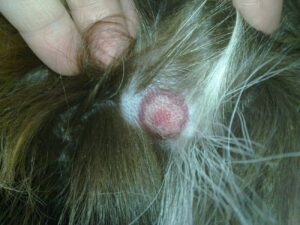
In 2015, the magazine, Business Insider called Lyme Disease a “hidden epidemic” and “public health fiasco.” Lyme is often identified by its tell-tale bulls-eye rash.
dierenziekenhuis from Pixabay” width=”300″ height=”225″>
If ignored, the rash disappears and goes deeper to develop into joint and muscle pain, fatigue and neurological disorders — such as numbness, tingling, weakness, and cognitive impairment.
If treated with antibiotics, the symptoms are suppressed for a time. However, in Nature, nothing stays hidden for long. Eventually, the truth reveals itself at a later date.
Three things cannot be long hidden: the sun, the moon, and the truth. – The Buddha
If you want the dirt on Lyme, you’ll have to unearth what remains hidden.
As a traditional naturopath and herbalist, I see many people who experience the common symptoms of fatigue, joint and muscle pain, and general discomfort. These symptoms may have started with fever and chills, and a headache, many years ago. But, eventually the disease expresses itself cyclically, on an annual or semi annual basis. People may eventually live with these symptoms a daily basis.
Symptoms change if even the old definitions do not.
The number of Lyme disease patients who do not fit the CDC’s epidemiologic definition continues to grow. The CDC’s case definition does not include many of the most common neurologic, psychiatric and chronic manifestations including fatigue, headaches, dizziness, irritability, poor memory and concentration, sleep disturbance, arthralgias, numbness, and myalgias. – Expert testimony by Dr. Daniel Cameron, MD, House Congressional Hearing.
When people think that their symptoms could not possibly be Lyme-related, either because: 1) they have never noticed a bulls-eye pattern rash around a bite site, 2) they do not spend time in Nature, or 3) they have not seen a tick in the city, I ask them to think again.
The Vectors: Biting Insects
OpenClipart-Vectors from Pixabay” width=”267″ height=”300″>
The latest information on Lyme is not headline news.
Today we know that the bacterium that causes Lyme disease is spread, not only by ticks, but also by biting insects, in general. That means many species of deer ticks, horse flies, deer flies, and mosquitoes can ALL harbor Borrelia burgdorferi, the bacterium responsible for Lyme disease.
How did all of the various species come together to host a bacterium-spirochete responsible for “a Public Health fiasco?”
These findings suggest that the novel linear plasmids of Borrelia originated through a horizontal genetic transfer across kingdoms.
Did genetic transfer across kingdoms take place in Nature? Or did the transfer happen in a lab?
Gordon Johnson from Pixabay” width=”168″ height=”300″>
The Tick Transfer
Lyme disease is named after Lyme, Connecticut—the town a few miles from a top-level biowarfare lab called Plum Island Animal Disease Research Center. Not only did this facility do outdoor tick experiments, but it also has a history of pathogen leaks. Note: The African Swine Fever virus keeps coming up…
According to a 1977 Newsday newspaper article, “The only place African Swine Fever virus existed in the Western Hemisphere was on Plum Island where it was experimented upon.”
According to a 2005 report by the GAO, the Plum Island experimented with pathogens that can potentially cause fatal diseases in humans, including West Nile virus, Nipah virus, Rift Valley Fever.
The origin of Lyme disease had once, over several years, been a focus of a 2012 Congressional House hearing. But, the Senate refused to take up the issue, a symptom of gridlock. The one thing gridlock in politics can accomplish is to keep secrets buried, indefinitely.
“Americans deserve the Truth: Did DOD Weaponize Ticks with Lyme Disease?” was the headline on September 22 in the Congressional Record as the Smith measure came before the House. – Karl Grossman, Shelter Island Reporter, 2021
In 2022, Russia claims the U.S. did similar experiments in Ukraine biolabs:
The culprit behind Lyme is said to be the bacterium, B. burgdorferi. Yet, this bacterium can exist in many morphological forms, including spirochetes, spheroplast (or L-form), round bodies, and biofilms. Whether genetically engineered or not, they have learned to adapt to survive and thrive.
maxek from Pixabay” width=”300″ height=”264″>
When conditions are considered unfavorable for the bacterial form, B. burgdorferi has the ability to morph into the dormant round body, then hide in a biofilm form. When conditions are favorable, however, it can shift back to its spirochete form.
This morphing ability might confuse even the experts who like to name new species after themselves. For instance, in 2016, a new species, called Borrelia mayonii, was discovered by the Mayo Clinic (hence mayonii). Published in the February 2016 Journal Lancet Infectious Diseases, this species was found mainly in Minnesota, Wisconsin and North Dakota, with different characteristics.
Instead of the telltale bull’s-eye pattern associated with B. burgdorferi, rashes on these patients were diffuse or spotty. In addition to the fever, headache, rash and neck pain that accompanies the usual form of Lyme disease, patients who had contracted the new species of bacteria also experienced nausea and vomiting.
Could the original form have morphed into a new version of itself? Could the bacterium be having a good laugh about its new Italian sounding identity?
I no longer identify as B. burgorferi. I am mayonii! – Lyme bacterium
The Power of Natural Immunity
Dr. Thomas Rau, Chief Medical Director of a Switzerland based clinic, found that those who do not heal have underlying co-factors, such as vaccine viruses, metals, and toxins, that prevent natural healing of Lyme disease. Dr. Rau’s team led further investigations into why some people were more vulnerable than others. Can you guess what they found?
People have the natural ability to overcome Lyme disease, unless they have a block to their vitality due to injury or blockages in the body.
Dr. Rau conducted one of the most effective treatment plans for Lyme disease in the world. He claims that only 10 to 20 percent of tick bites led to stage 1 Lyme disease. If untreated, 30 percent of stage 1 diagnosis led to stage 2, of which one percent led to stage 3.
The Stages of Lyme Disease
Stage 1: common flu symptoms
Stage 2: problems of the skin, joints, nervous system, and heart
Stage 3: neurological problems and paralysis, psychological issues, eye problems, and chronic fatigue
It’s worth repeating: people self- heal, but only if the innate immune system is strong. Pathogens have no power of their own. Thus, it is important to detox chemicals and metal residues in the body and open the eliminatory channels.
Medical Remedies
In the medical world, Lyme is considered to be a bacterial infection and treated using the antibiotics doxycycline and amoxicillin. However, if the spirochete travels to the brain, antibiotics cannot follow.
Physicians who go outside their “standard of care” can face disciplinary charges as Swedish doctor, Kenneth Sandström did in 2017. Although antibiotics may be a good first step, if the spirochete shape-shifts to a mycoplasma form, or biofilm, then all bets are off.
Fortunately, when old strategies fail, Nature is ever present!
Natural Remedies
The successful persistence of spirochetes within the host depends on evading the host’s immune system, e.g. hiding of spirochetes within the extracellular matrix rather than using the host tissues for reproduction or growth. Parasites and Vectors, May 2019
Cannabisis also a known to put Lyme out of commission. Further, homeopathy can uproot Lyme disease easily. For some specific homeopathic remedies in use, see Joette Calabrese’s Practical Homeopathy. Naturopath, Dr. Klinghardt recommends Cistus tea.
Master Herbalist and author, Stephen Buhner, believed that the most important herbal remedies against Lyme are the strongest bitters. Master Herbalist, Matthew Wood agrees:
…the strong bitters make you shake or shudder and that means a chill is going down through the sympathetic nervous system and that these remedies (1) will “shake out” deep chills (like in Lyme and malaria) and (2) go deeply into the body.
The extremely powerful bitters with a reputation here are: teasel, andrographis (“father of bitters” in Ayurveda), and cat’s claw. Sweet Annie (Artemisia annua) is from a very bitter family, but is less bitter than its cousin; it should be classified here. I believe these remedies drive the spirochetes or co-factors out of the muscles, and the brain, into the blood, where our own immune system slowly kills them off.
Support for some herbs identified above, as well as Skullcap (Scutellaria lateriflora), Black walnut (Juglans nigra), and Japanese knotweed (Polygonum cuspidatum), are found in the 2020 Journal of Front Med (Lausane), titled, “Evaluation of Natural and Botanical Medicines for Activity Against Growing and Non-growing Forms of B. burgdorferi.”
Other herbs such as boneset (Eupatorium perfoliatum) and Cryptolepis sanguinolenta), also demonstrate the versatility and power of how Nature work with the body’s intelligence to bring back balance, thus showing how all healing is individual.
Nature offers many options to restore health. So there is no need to “live with Lyme” or any disease. You can eliminate it and go back to your life without fear that Lyme has a hold on you. Then, if it happens again, you know the herbs are there for you. For more information, seek out a natural health practitioner.
From Lyme to Covid!
Silvia from Pixabay” width=”223″ height=”356″>
A diagnosis of “Chronic Lyme” is often used an excuse to prescribe long-term antibiotics, just as “Long Covid” is an excuse to market new medical drug treatments coming down the pipeline. Is there a connection between Lyme and Covid? Is Lyme linked to African Swine fever through Covid and U.S. biolabs in Ukraine?
Defense Ministry alleges US-sponsored labs studied possibility of transfer of African swine fever, anthrax through infecting birds, bats, reptiles. – Elena Teslova, October 2022
There’s the question of whether COVID-19 might have started at a laboratory in China. And for decades there’s the issue of how Lyme disease began. Both cry out for vigorous and full investigations. – Karl Grossman, Shelter Island Reporter, 2021
No matter how or when Lyme was created, Lyme disease is here, in a majority of the population. Whether you notice a bulls-eye rash or not, whether you are a city slicker or the back-woods type, whether human or dog or sheep, or a bat in a lab experiment, the Lyme bacterium does not seem to discriminate against any mammal.
Over the last few decades, Rife machines and other frequency therapies have attempted to target pathogens, including parasites and Lyme. Unfortunately, these machines are unable to keep up with these shape-shifters, which easily shift their frequency when targeted.
Thus, the best defense against Lyme disease a strong offense. Today a strong offense not only requires a strong innate immune system, but also a strong mind with the ability to acquire knowledge, discern that knowledge, and act on that knowledge.
Since all healing happens from within, it makes sense to embrace the inside-out dynamic of self-healing that is Nature’s way.
Related Articles:
Disclaimer: The author is not a medical doctor. All information on Natureofhealing.org is provided in good faith. However we make no representation or warranty of any kind, express or implied, regarding the accuracy, adequacy, validity, reliability, availability, or completeness of any information on the site. Under no circumstance shall we have any liability to you for any loss or damage of any kind incurred as a result of the use of this site or reliance on any information provided on this site. Your use of this site and reliance on information on this site is solely at your own discretion.
Two men from Ontario who operated an illicit cannabis website and delivery service in PEI received conditional sentences from a Supreme Court Justice in PEI in May.
The two men, David Jones and Aaron Jones Braithwaite, aged 48 and 24, respectively, were running what police described as an illicit cannabis delivery company operating online. Charlottetown Police investigated the operation in 2021, following information received about the business.
Police say they arranged several controlled buys from the website in March and April 2021, including several hundred dollars worth of cannabis, hash, shatter, and edibles.
Following the fourth controlled purchase from police in April 2021, the two men were arrested. Police seized 1,901.3 grams of dried cannabis; 218 grams of cannabis edibles; 173.2 grams of shatter cannabis concentrates, nearly $2,500 in Canadian currency, and other materials related to the business.
Unfortunately, it’s been described as a whack-a-mole: We take down one site and two more open up.
Chief Serr, Abbotsford BC Police Chief
The court report notes that Jones had initially believed he could transition his business into a legal, licensed delivery service but has since acknowledged his efforts were not compliant with provincial and federal regulations.
The judge in the case issued a conditional sentence to both men. Jones was sentenced to imprisonment for 18 months to be served in the community, subject to numerous conditions, including house arrest for a period of 14 months, and a curfew following the house arrest and community service. He was also sentenced to probation for a period of two years.
Braithwaite was sentenced to imprisonment for 14 months to be served in the community, subject to numerous conditions, including house arrest for a period of 11 months, and adherence to a curfew following the house arrest and community service. He was also sentenced to probation for a period of 18 months.
The number of illicit online cannabis sites has only increased following cannabis legalization, with some former brick-and-mortar businesses moving online to avoid enforcement.
While there have been some notable instances of enforcement against illicit online retailers, law enforcement says it lacks the resources to target them all.
“Unfortunately, it’s been described as a whack-a-mole: We take down one site and two more open up,” Abbotsford BC Police Chief, Chief Serr told the Globe and Mail at the time.
“If you were to do a simple Google search, you would see numerous sites coming up, and one of the issues for consumers is it’s really difficult to tell online who is a legal seller and who is an illegal seller.”
A popular subreddit geoblocked a forum dedicated to illicit online retailers in Canada earlier this year, although the subreddit is still easily accessible.
Earlier in the year, BC’s director of civil forfeiture announced it was seeking to confiscate cash and eight properties worth nearly $7 million alleged to be connected to three illicit cannabis websites.
In 2020, Ontario Provincial Police (OPP), along with the Ontario Provincial Joint Force Cannabis Enforcement Team (PJFCET), conducted a raid on an illicit online cannabis retailer.
The possibilities for life after death come down to a mere three:
One: There is no life after death. Death is the total extinction of consciousness. Two: Life after death continues on earth (through reincarnation). Three: Life continues after death on another plane than that of earthly reality (such as in heaven or hell).
If we’re going to talk about this subject at all, we can rule out the first option categorically, especially since practically every culture and religion teaches that there is some form of life after death. There are many discussions of the evidence for the afterlife, and while this is a fascinating subject, it’s out of the scope of this article.
Which, then, of the two remaining options is most likely? Usually these are simplistically conceived. You reincarnate: depending on your karma, you come back down to earth to live again as a sage or a stockbroker. Or you are judged before the heavenly throne and are sent up to heaven or down to hell once and for all.
The Gnostics, the mysterious esoteric teachers of the early centuries of the Common Era, had their own perspective on the afterlife. Although their teachings have been all but lost, enough material remains so that we can reconstruct them. If we do, we will reach some valuable insights not only about some elements of the later Western occult traditions but about the project of spiritual liberation.
The Gnostic texts speak very little about reincarnation. We do, however, find some references to this concept in the Corpus Hermeticum (“Hermetic body” of writings). Probably written in the first to third centuries CE, they largely consist of dialogues between a divine figure named Hermes Trismegistus and his son Tat (or Thoth, the Egyptian god that most resembled the Greek Hermes). Their origin is suggested by the title of the leading treatise: Poimandres (from which I’ll quote below). This is a Grecization of p-eime-n-re, “illumined mind” in Egyptian. The Hermetic texts were descriptions of ancient Egyptian esoteric knowledge recast in the language and thought of the Greeks, who were culturally dominant in the Mediterranean world of that time. The Hermetic texts aren’t usually considered to be Gnostic per se, although their ideas were extremely similar to those of the Gnostics and can be taken as part of the same milieu.1
The Hermetic texts speak of reincarnation, but not in the sense familiar from New Age versions of the doctrine. The Hermetic writings generally portray reincarnation as a punishment. One treatise tells us that a person who dies childless “is sentenced to a body that has neither a man’s nature nor a woman’s – a thing accursed under the sun.” And a text known as the Asclepius says that “those who live faithfully under god” will ascend to become divine beings, but “for the unfaithful it goes differently: return to heaven is denied them, and a vile migration unworthy of a holy soul puts them in other bodies.”2
Both the Hermeticists and the Gnostics were much more interested in the spirit’s ascent after death. In order to understand their views, we have to set aside one background assumption that we may have received from conventional Christianity: that heaven is all good, that, as it were, all the evil is down below. As a matter of fact, the Gnostics say little about hell as such. To them the dangers encountered by the spirit after death took a very different form.
Meet the Archons
If you read even a small amount about Gnosticism, you will come across references to the archons, whose name comes from a Greek word meaning “rulers.” Malign spiritual powers, they stand in the celestial realms interposed between us and the true, good God far above. Who are these archons?
Although it’s sometimes forgotten, the Gnostics took much of their inspiration from the apostle Paul. One key verse appears in Ephesians (an epistle that, most scholars today agree, was not actually written by Paul, although it was attributed to him): “For we wrestle not against flesh and blood, but against principalities, against powers, against the rulers of the darkness of this world, against spiritual wickedness in high places” (Eph. 6:12).3 Although the verse does not use the word archons (in the Greek New Testament, this word usually refers to human rulers; cf. Luke 12:58, John 3:1), the word translated as “principalities” is arkhas, which comes from the same root. The writer of Ephesians is saying that these “rulers of the darkness of this world” are in the celestial spheres that are interposed between the earth and the realms of the true heaven far above. For the Gnostics, this meant that there are two heavens: one a sinister, intermediary realm of the archons, the other the realm of the true, good God above. To reach the true heaven (sometimes called the Pleroma or “fullness”) after death, the spirit has to pass through the spheres of the archons.
There were many Gnostic systems, and their critics sometimes complained that they changed their teachings every day. But in essence both Gnosticism and Hermeticism envisaged the journey of the spirit in the afterlife as an ascent through the realms of the concentric spheres surrounding the earth. Often these were associated with the seven planets as understood by the ancients: the moon, Mercury, Venus, the sun, Mars, Jupiter, and Saturn (in that order), each of which had its own ruler or archon. The clearest and most concise description of this process appears in the Poimandres, which describes the bad qualities the spirit must shed after death in each planetary zone:
Thence the human being rushes up through the cosmic framework, at the first zone [the moon] surrendering the energy of increase and decrease; at the second [Mercury] evil machination, a device now inactive; at the third [Venus] the illusion of longing, now inactive; at the fourth [the sun] the ruler’s arrogance, now freed from excess; at the fifth [Mars] unholy presumption and daring recklessness; at the sixth [Jupiter] the evil impulses that come from wealth, now inactive; and at the seventh zone [Saturn] the deceit that lies in ambush. And then, stripped of the effects of the cosmic framework, the human enters the region of the ogdoad [the spiritual realm]; he has his own proper power, and along with the blessed he hymns the father.4
Another portrait of the soul’s ascent appears in Contra Celsum (“Against Celsus”), a polemical work written by the Church Father Origen (c.185–c.254 CE). Origen at one point describes the teachings of a Gnostic sect called the Ophites. Not much is known about them, but they were so called from the Greek word ophis (“serpent”). Unlike orthodox Christianity, they regarded the serpent of Genesis as a positive figure, bringing Adam and Eve gnosis or knowledge.
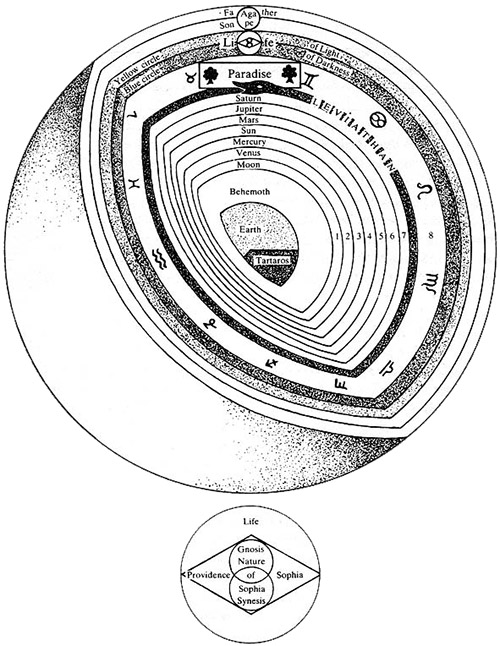
Ophite Gnostic cosmology symbolising the structure of Reality.
The world serpent Leviathan encircles the planetary realm, with Saturn on the boundary. After death the soul/spirit attempts to ascend through the spheres of the archons that are identified with the planets.
The Ophites, Origen tells us, believe that after death the soul has to pass through a “barrier of evil.” Then it has to confront a series of archons, who are associated with the planets. In ascending order from the earth, they are:
1. Moon: Horaeus
2. Mercury: Ailoaeus or Eloaeus
3. Venus: Astaipheus
4. Sun: Adonai
5. Mars: Sabaoth
6. Jupiter: Iao
7. Saturn: Ialdabaoth
(Note that the order is the same as in the Poimandres.) In order to pass through these spheres, the Gnostic initiate was taught what to say to the archons and which symbol to present to them as a kind of passkey. To Ialdabaoth, for example, one is supposed to say:
And thou, Ialdabaoth, first and seventh, born to have power with boldness, being ruling Word of a pure mind, a perfect work for Son and Father, I bear a symbol marked with a picture of life, and having opened to the world the gate which thou didst close for thine eternity, I pass by thy power free again. May grace be with me, father, let it be with me.5
Irenaeus of Lyons, the second-century Church Father whose work Against the Heresies is one of our chief primary sources about Gnosticism, describes another view of this process. Speaking of one school of Gnostics, he writes:
These hold that the knowledge of the unspeakable Greatness is itself perfect redemption. For since both defect and passion flowed from ignorance, the whole substance of what was thus formed is destroyed by knowledge; and therefore knowledge is the redemption of the inner man. This, however, is not of a corporeal nature, for the body is corruptible; nor is it animal, since the animal soul is the fruit of a defect, and is, as it were, the abode of the spirit. The redemption must therefore be of a spiritual nature; for they affirm that the inner and spiritual man is redeemed by means of knowledge, and that they, having acquired the knowledge of all things, stand thenceforth in need of nothing else. This, then, is the true redemption.6
Soul, Spirit & the Afterlife
Irenaeus indicates that the Gnostics believed in a tripartite division of the human entity: the physical body, the soul (what Irenaeus calls the “animal soul”), and the spirit. Orthodox Christianity originally had the same teaching, although it would be lost over the centuries. Today you will have great difficulty finding a churchman of any denomination who can explain to you the difference between the soul and the spirit.7 But the Gnostics thought these two things were very different indeed, and this fact provides the key to their views of the afterlife.
When you read a standard version of the New Testament and come across the word “soul,” it is almost always translating the Greek word psyche. That’s what “soul” originally meant. It is the psyche – the constellation of thoughts and feelings, conscious and unconscious, that constitute your inner life. It also includes the vital principle, or life force (the “animal soul”). As the passage from Irenaeus suggests, the Gnostics knew that this soul was not immortal and was not meant to be.
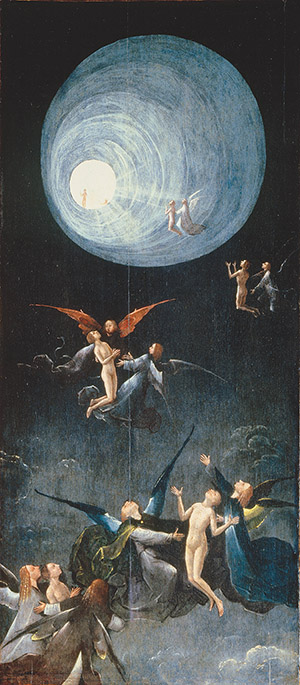
‘The Ascent into the Empyrean or Highest Heaven’ by Hieronymus Bosch
The spirit is another matter. It is that in you which, at the deepest level, says “I.” It is the principle of pure consciousness that looks out of your body and psyche as through a telescope. There are many names for it: Atman, the Self, the kingdom of heaven, ruach in Hebrew and pneuma in Greek. This principle is immortal and indestructible; it will remain long after both body and soul have disintegrated.
In fact the soul is supposed to disintegrate. It is made up of planetary influences (hence it is sometimes given the name “astral body”), which are as temporary and transitory as the combinations of molecules that make up the physical body. The Gnostics conceived of incarnation as a descent from the supernal realms through the spheres of the seven planets down to earth. As the spirit made its way through these spheres, it takes on the colouration of each of these planets. Conversely, at the time of death, the spirit ascends and (at least ideally) shakes off the influence of each planet in turn, since these influences are the shackles that bind the soul to materiality. That’s why the Hermetic text quoted above tells us that “the human being rushes up through the cosmic framework, at the first zone [the moon] surrendering the energy of increase and decrease” and so on. Some of the Gnostics, such as the Ophites, thought it was necessary to know the occult names of each of the archons guarding these tiers as a way of getting through (in ancient magic, to know the name of something is to have power over it).
Others, like the ones described by Irenaeus, apparently believed that the mere knowledge of the situation was enough for liberation.
For individuals who do not have access to this salvific knowledge in one form or another, “it goes differently,” as we read in the Hermetic text quoted above: “return to heaven is denied them, and a vile migration unworthy of a holy soul puts them in other bodies.”
Reincarnation Undesirable
Reincarnation today is an increasingly popular belief. Surveys show that about 20–25% of the population of the Western countries (and as many as a third of the people in Russia) believe in it. It has the advantage of being more reassuring than the conventional Christian view that you could fry in hell for an infinite amount of time as punishment for sins committed for an extremely finite amount of time on earth. And there is a considerable body of work attesting to past-life memories (Ian Stevenson is a pioneer in this field), so that reincarnation is far better-validated than scientistic materialism would have us believe.
Nonetheless, practically all the traditions that teach reincarnation view it as undesirable. We can come back, but if we do, it is the result of a problem or a mistake on our part. The ideal fate for an individual in Hinduism is moksha or liberation from the chain of incarnation; nirvana has the same position in Buddhism. The celebrated Tibetan Book of the Dead consists of step-by-step instructions for the newly deceased in how to avoid reincarnating. The Gnostics and Hermeticists portrayed this liberation as the ascent of the spirit through the realm of the hostile archons into the Pleroma.
Even the position of reincarnation in conventional Christianity is not quite what you might expect. Astonishingly, the doctrine of reincarnation has never been explicitly repudiated by the Catholic Church, even though most of its theologians have dismissed or derided it. Today some people claim that the doctrine was rejected either by the First Council of Nicaea in 325 CE or by the Second Council of Constantinople in 553, but as a matter of fact neither of these dealt with the topic; instead they were concerned with the nature of Christ. One source of this misconception is Shirley MacLaine, the actress and New Age author, who introduced these ideas in her highly popular books, adding further to the confusion by mixing up the two councils.8
At any rate, reincarnation sits ambiguously on the edge of the Christian tradition. Valentin Tomberg (1900-73), a Baltic German convert to Roman Catholicism whose Meditations on the Tarot, published anonymously, remains one of the great modern classics of esoteric Christianity, observes:
The Church was hostile to the doctrine of reincarnation, although the fact of repeated incarnations was known – and could not remain unknown – to a large number of people faithful to the Church with authentic spiritual experience. The deeper reason is the danger of reincarnation by way of the ghost, where one avoids the path of purification (in purgatory), illumination and celestial union. For humanity could succumb to the temptation of preparing for a future terrestrial life, instead of preparing for purgatory and heaven, in earthly life.9
If you set aside the Catholic term of “purgatory” in this passage, you end up with a view very much like that of the Gnostics. The spirit is purified and illumined in its ascent, and eventually enters the realm of the Father. The “ghost” of which Tomberg speaks is a soul – that is, an astral body – that has not properly disintegrated. It either lurks around the earth, causing ghostly phenomena, or becomes entrapped in yet another physical body.
Curiously, the Gnostic teachings also survived in Eastern Orthodoxy, which owes more to Gnosticism than it cares to admit. Orthodox Christianity uses the quaint but vivid metaphor of “aerial tollhouses” to speak of the spirit’s perilous ascent after death. The number of these tollhouses is usually said to be twenty. Here is one account, attributed to Taxiotes, a soldier in antiquity who had a near-death experience:
When I was dying, I saw Ethiopians who appeared before me. Their appearance was very frightful; my soul beholding them was disturbed. Then I saw two splendid youths, and my soul leaped out into their arms. We began slowly to ascend in the air to the heights, as if flying, and we reached the toll-houses that guard the ascent and detain the soul of each man. Each toll-house tested a special form of sin: one lying, another envy, another pride; each sin has its own testers in the air. And I saw that the angels held all my good deeds in a little chest; taking them out, they would compare them with my evil deeds. Thus we passed by all the toll-houses. And when, reaching the gates of the heavens, we came to the toll-house of fornication, those who guard the way there detained me and presented to me all my fleshly deeds of fornication, committed from my childhood up to now. The angels who were leading said to me, “All the bodily sins which you committed in the city, God has forgiven, because you repented of them.” To this my adversaries said to me, “But when you left the city, in the village you committed adultery with a farmer’s wife.” The angels, hearing this and finding no good deed which could be measured out for my sin, left me and went away. Then the evil spirits seized me, and overwhelming me with blows, led me down to earth. The earth opened, and I was let down by narrow and foul-smelling descents into the underground prison of hell.10
It’s easy to find resemblances in this passage to the Gnostic and Hermetic texts we’ve already examined. The basic process is the same: the soul ascends through the aerial region toward heaven but encounters sentinels that bar its way. The Gnostic texts saw the way through in esoteric terms: it was necessary to know the name of the archon guarding each one and to know how to address him, or at any rate to understand the truth of the situation. Here, in an Orthodox Christian context, it is a matter of purity from sin. (As a matter of fact, the seven planets are associated with the seven deadly sins: the moon, with envy; Mercury, with sloth; Venus, lust; the sun, pride; Mars; anger; Jupiter, gluttony. The seventh, covetousness, is associated with the earth, but as we can see from the Poimandres, the seventh is sometimes taken to be deceit, and is associated with Saturn.) Like the Gnostics, the Orthodox regard these aerial tollkeepers as evil spirits. Their leader is the Devil, “the prince of the power of the air, the spirit that now worketh in the children of disobedience” (Eph. 2:2).
Echoes of Gnostic ideas resonate in other forms of esotericism. Here is one passage from the Zohar, the central text of the Kabbalah, the mystical tradition of Judaism. A rabbi tells of his encounter with some “children of the East” and their books of sacred wisdom, which, he says, resemble the teachings of the Jewish Torah. These books from the East said that:
It is by his acts, by his words, and by his fervency and devotion that [the worshipper] can draw to himself that spirit from on high. They further said that if a man follows a certain direction in this world, he will be led further in the same direction when he departs this world; as that to which he attaches himself in this world, so is that to which he will find himself attached in the other world; if holy, holy, and if defiled, defiled. If he cleaves to holiness he will on high be drawn to that side and be made a servant to minister before the Holy One among the angels…. Similarly if he clings here to uncleanness, he will be drawn there towards that side and be made one of the unclean company and be attached to them. These are called “pests of mankind,” and when a man leaves this world they take him up and cast him down into Gehinnom [i.e., hell].11
The rabbi also says that these books also have “rites and ceremonies pertaining to the worship of the stars, with the requisite formulas and the directions for concentrating the thoughts upon them, so as to draw them near the worshipper.” These would seem to resemble the Gnostic formulas and directions for encountering and passing through the gates of the archons, who are associated with the planets. But the rabbi discourages this kind of practice, saying that Jews are to worship the Holy One alone.
It would be possible to trace the threads of these Gnostic ideas in many more directions, certainly in the Kabbalah. Gershom Scholem, the greatest twentieth-century scholar of the Kabbalah, emphasised that “it was Gnosticism, one of the last great manifestations of mythology in religious thought… which lent figures of speech to the Jewish mystic.”12
Such is the view of the scholar. He sees affinities and resemblances between texts and traditions, and naturally assumes that the earlier ones must have influenced the later ones. But someone who wants to transcend the limits of mere academic scholarship has to ask another question: are these similarities the result of influence in a conventional sense, or is it rather that these mystics and illuminates of different traditions saw the same reality and tried to express it in terms of their own language and thought? I myself suspect that both of these things are true.
What, then, is the mystical reality to which all these teachings point? I would suggest that it is something like this: The psyche, the soul, is made up not only of planetary influences (which is why the natal horoscope is believed to give the key to your character) but of the concepts and conditioning that were attached to it over the course of an incarnation. The Tibetan Book of the Dead, which describes this process in Tibetan Buddhist terms, calls this complex “the thought-body of propensities.”13 The ascent through the realms of the archons or the aerial tollhouses represent the stripping away of these influences, including concepts and conditioning of a religious nature. If the break is more or less complete, the unconditioned spirit can make its way to the “true heaven” – that is, other realms of existence where it will continue to be perfected. If not, it is thrown back down to earth (or perhaps to still darker realms) for another round. The Tibetan Book of the Dead says that the way to penetrate through the bardos (the Tibetan equivalent of the tollhouses) is to “know these apparitions to be thine own thought-forms.”14
What practical conclusions can we draw from all this? Personally I would point back to the passage from the Zohar quoted just above: “If a man follows a certain direction in this world, he will be led further in the same direction when he departs this world.” The future of the divine monad, the spark of pure consciousness that lies at the centre of our being like a jewel in a lotus and whose refinement and perfection is perhaps the sole purpose of human existence, will be determined by how we cultivate it in this life. For all of the archons and celestial tollkeepers that may appear to face us after death, the responsibility for our evolution – or, if you like, salvation – continues to rest with ourselves.
If you appreciate this article, please consider a contribution to help maintain this website.
Footnotes
1. For further discussion of this topic, see my Forbidden Faith, 32–35.
2. Asclepius 12, in Brian P. Copenhaver, ed. and trans., Hermetica: The Greek Corpus Hermeticum and the Latin Asclepius in a New English Translation, with Notes and an Introduction (Cambridge: Cambridge University Press, 1992), 74; Corpus Hermeticum II, 17, in Copenhaver, 12.
3. Biblical quotations are from the Authorised (King James) Version.
4. Corpus Hermeticum I, 25–26; in Copenhaver, 6.
5. Origen, Contra Celsum, 6.31; in Henry Chadwick, ed. and trans., Contra Celsum, rev. ed. (Cambridge: Cambridge University Press, 1965), 347.
7. For more on this subject, see my article “Christianity: The Ultimate Secret,” New Dawn No. 84 (May-June 2004), 27–32; also my Inner Christianity, 19–20, 70–71 et passim.
8. See Wouter J. Hanegraaff, New Age Religion and Western Culture (Albany: State University of New York Press, 1998), 321-22.
9. Meditations on the Tarot: A Journey into Christian Hermeticism, trans. Robert A. Powell (Warwick, N.Y.: Amity House, 1985), 361. Emphasis in the original.
10. Quoted in Seraphim Rose, The Soul after Death (Platina, Calif.: St. Herman of Alaska Brotherhood, 1980), 84.
11. Zohar 1, 99b; in The Zohar, Harry Sperling and Maurice Simon (London: Soncino, 1934), vol. 1, 324–25.
12. Gershom Scholem, Major Trends in Jewish Mysticism, 3d ed. (New York: Schocken, 1961), 35.
13. The Tibetan Book of the Dead, W.Y. Evans-Wentz, ed. and trans., 3d ed. (New York: Oxford University Press, 1957), 104.
RICHARD SMOLEY is the author of Inner Christianity: A Guide to the Esoteric Tradition; The Dice Game of Shiva: How Consciousness Creates the Universe; Conscious Love: Insights from Mystical Christianity; The Essential Nostradamus; Forbidden Faith: The Secret History of Gnosticism; Supernatural: Writings on an Unknown History; The Deal: A Guide to Radical and Complete Forgiveness; How God Became God: What Scholars Are Really Saying about God and the Bible; and Hidden Wisdom: A Guide to the Western Inner Traditions (with Jay Kinney). A frequent contributor to New Dawn, he is editor of Quest: Journal of the Theosophical Society in America. Visit his blog at www.innerchristianity.com/blog.htm.
Maryland authorities are currently open to receiving grant applications aimed at assisting established medical marijuana enterprises in transitioning into dual license holders, enabling the businesses to cater to the recreational market once legalization comes into effect in the upcoming month. In addition, the state’s Department of Commerce (DOC) has announced that beginning on Aug. 1, 2023, it will start accepting applications for loans and grants intended to enhance market engagement from holders of social equity licenses by providing initial capital and covering operational costs.
The fund, established by a recent marijuana legislation bill signed by Governor Wes Moore in May, will also provide grants to HBCUs (historically black colleges or universities) for cannabis-related programs, such as initiatives for training and business development.
For the initial phase of assistance, the DOC has announced its acceptance of applications for grants covering medical license transition fees. These grants will cover the application expenses for established medical cannabis dispensaries, growers and processors that need to transition into dual license holders according to the draft regulations recently released by the MCA.
Qualifying businesses can potentially obtain grants ranging between $25,000 and $50,000, depending on their license type, to facilitate the transition. Applications will be reviewed and approved progressively until the end of June. Businesses that meet the criteria but have already paid the fee may also apply for a refund.
To qualify, applicants must be small businesses with a maximum of 50 employees as of May 1, 2023. Additionally, the enterprise must be at least 51% owned by people whose net worth doesn’t surpass $1.7 million.
During a subsequent round of assistance scheduled for August 2023, the state will utilize the same fund to distribute loans to social equity enterprises that obtained preapproval prior to Oct. 1, 2022, and have the capacity to start up and take part in the marijuana industry.
A third initiative supported by the fund will promote HBCU marijuana-related programs, which will aid enterprises in the license application process, as well as boost development organizations such as incubators. The funds will also be used to train and assist small firms, particularly those run by women and minorities, as well as business owners who want to join the recreational marijuana industry.
Maryland’s cannabis regulators recently unveiled a set of preliminary emergency regulations that are currently awaiting assessment by the AELR committee. These regulations must also undergo publication in the Maryland Register prior to their implementation.
The comprehensive draft, spanning 41 pages, introduces explicit definitions, formalizes limits on personal possession, delineates the obligations of regulatory entities, elucidates the licensing process (including provisions for social equity candidates), specifies the powers of enforcement agencies, and outlines the consequences and fines for noncompliance. Additionally, the document establishes clear guidelines for labeling and packaging.
As the recreational marijuana program in Maryland takes shape and gets underway, there is likely to be a boom in economic activity for a wide-ranging variety of enterprises, such as Advanced Container Technologies Inc. (OTC: ACTX), which seek to provide supplies such as grow pods that cultivators need to grow marijuana more profitably.
NOTE TO INVESTORS: The latest news and updates relating to Advanced Container Technologies Inc. (OTC: ACTX) are available in the company’s newsroom at https://cnw.fm/ACTX
About CNW420
CNW420 spotlights the latest developments in the rapidly evolving cannabis industry through the release of two informative articles each business day. Our concise, informative content serves as a gateway for investors interested in the legalized cannabis sector and provides updates on how regulatory developments may impact financial markets. Articles are released each business day at 4:20 a.m. and 4:20 p.m. Eastern – our tribute to the time synonymous with cannabis culture. If marijuana and the burgeoning industry surrounding it are on your radar, CNW420 is for you! Check back daily to stay up-to-date on the latest milestones in the fast -changing world of cannabis.
To receive instant SMS alerts, text CANNABIS to 21000 (U.S. Mobile Phones Only)
Please see full terms of use and disclaimers on the CannabisNewsWire website applicable to all content provided by CNW420, wherever published or re-published: http://CNW.fm/Disclaimer
Do you have questions or are you interested in working with CNW420? Ask our Editor
St Joseph-de-Kent, N.B. — Greenherb Farms is reaching another milestone after receiving their Farmgate license on April 20, 2023.
Since then, the team has been preparing for the store’s grand opening weekend, starting on Friday, June 23rd, and continuing through the 24th and 25th. The store will have special hours during the weekend to allow for a proper celebration of this exciting achievement.
This will be a unique experience for cannabis enthusiasts, industry professionals, and members of the local community. Visitors will have the opportunity to purchase Greenherb cannabis products directly from the farm at a discounted rate. Additionally, they will have the chance to ask questions and learn organic farming techniques from the Greenherb team.
Greenherb expects that the Farmgate’s location will contribute to an increase in cannabis tourism in New Brunswick. Both tourists and locals will soon be able to purchase cannabis, book tours, enjoy special events, take lessons, and participate in cannabis research right on the farm. There is much to look forward to for cannabis enthusiasts traveling from around the world to beautiful New Brunswick.
Advertisement
“We are thrilled to open our doors to the public and share the fruits of our labor,” said Greg Claroni, GM of Greenherb Farms. “Our Farmgate license represents the culmination of 7 years of dedication and hard work. We are eager to showcase our commitment to sustainable practices, product quality, and community engagement, and we look forward to building long-lasting relationships with our customers and partners.”
Visit greenherbfarms.org for event details and special offers and join us on June 23rd, 24th, and 25th at 1045 Chemin St Joseph, St Joseph-de-Kent, N.B.
American Pot Story: Oaksterdam celebrates its East Coast premiere at the Lighthouse International Film Festival located at Long Beach Island, New Jersey, June 7-11, 2023.
The film revolves around Oaksterdam University (OU), the world’s first cannabis college, and tells the unknown origin story of the people who took monumental risks to make cannabis legalization possible. It celebrates the courageous heritage of the legacy industry and the movement that started at OU and would go on to impact the world.
More than $100 million worth of cannabis was sold in Nova Scotia last year.
Nova Scotia sold $111.1 million worth of cannabis in the fiscal year ending March 31, 2022, an increase of 9 percent compared to the previous year according to the most recent annual report.
Transactions involving cannabis also increased, by 12.7 percent. While the average basket size decreased by 3.1 percent to $38.40, this is likely due to a 2.8 percent reduction in the average price per gram of $6.19.
The Nova Scotia Liquor Corporation (NSLC) which oversees cannabis sales in the province also added 11 new cannabis stores, for a total of 48 across the province.
“We continue to look for ways to compete with the illicit cannabis market and offer Nova Scotians an accessible and safe supply of cannabis,” said Greg Hughes, NSLC president & CEO said. “This includes finding ways to partner with local cannabis producers and help them bring their products to market.”
The NSLC has also been promoting Nova Scotia-grown cannabis products. These products accounted for over 30 percent of all cannabis sales in the province, an increase year-over-year of nearly 42 percent for a total of $33.5 million in sales.
Revenue from cannabis sales in Nova Scotia goes towards the funding of “key public services”.







 dierenziekenhuis from Pixabay” width=”300″ height=”225″>
 OpenClipart-Vectors from Pixabay” width=”267″ height=”300″>
 Gordon Johnson from Pixabay” width=”168″ height=”300″>
 maxek from Pixabay” width=”300″ height=”264″>
 Lukasz from Pixabay” width=”300″ height=”300″>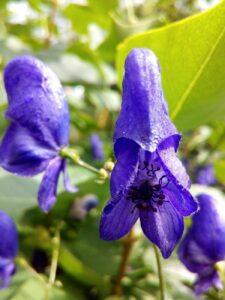
 Silvia from Pixabay” width=”223″ height=”356″>







Recent Comments