New Brunswick’s first privately-owned cannabis store is open for business as of June 14.
Cannabis Xpress, located in Grand Bay-Westfield, a town of about 5,000 located 15 minutes outside of Saint John, is the first of up to ten private retail locations that the province opened up applications for in 2022.
Although privately-run, the retailer will still be required to purchase products from Cannabis NB.
The provincial government, which first announced its plans for around a dozen new stores in 2021, began the vetting process for ten new private cannabis stores following a tender process that ended in October 2022.
The goal was to bring cannabis to smaller, under-served communities. Tenders were accepted for Blackville, Bouctouche, Caraquet, Chipman, Dalhousie, Grand Bay, Hampton, Saint Andrews, Saint-Quentin, and Salisbury.
Cannabis NB is currently the only legal retailer in the province, with 25 locations. Most of these locations are in or near cities like Moncton, Saint John, and Fredericton. All ten new private retail locations are in towns with fewer than 10,000 residents, most with just a few thousand or fewer.
“The goal of having private retail locations is to combat the illicit market by providing better access to safe, regulated cannabis products in underserved areas of the province,” said Cannabis NB president Lori Stickles in 2022.
Cannabis Xpress already operates 14 cannabis stores in Ontario. This is their first foray into the New Brunswick market.
Chris Jones, the owner of the new retail store, tells StratCann that he and his team are excited to enter the market and look forward to supporting the local community while continuing to expand/seek opportunities in Ontario, New Brunswick, and other limited license provinces.
“Our whole team is excited about the opening of the new store this week,” says Jones. “It was a new process for us to expand into another province. Over the last few months, we have spoken to many people in the community who have been extremely supportive of us, including the town council, and residents.”
In the agency’s most recent quarterly report in January, total sales were $21.6 million, an increase of 5 percent compared to the same period last year. Net income for the quarter was $4.8 million, 21.5 percent above the previous year’s third-quarter net income of $3.9 million.
New Brunswick has taken some relatively unique approaches to cannabis retail since opening its public-only model in 2018. In addition to being one of only two provinces with a mixed public and private retail mode (BC is the other), it is one of only three provinces (along with Ontario and BC) to have a formal farmgate retail licensing system in place. There are currently five cannabis producers in New Brunswick now licenced to allow on-site sales direct to consumers, including the recent addition of a cannabis nursery.
The province has also operated several pop-up Cannabis NB locations, and the agency is currently holding its third annual Cannabis NB Cup, featuring products from 13 growers across Canada.
Judging will remain open until June 19. Results will be announced in late June.
Montréal — Quebec’s provincially-owned cannabis retailer says its growth has plateaued for the first time despite an increasing number of pot shops because some two dozen stores have been affected by strikes.
On both a volume and dollar basis, the Societe quebecoise du cannabis says its sales remained stable in its 2022 to 2023 fiscal year, a shift away from the sustained growth it saw over the last four years.
The SQDC had total sales of $601.9 million and 106,526 kg of cannabis in the 2022 to 2023 fiscal year, which compared with $600.5 million and 106,448 kg the year earlier.
It blamed the plateau in the period ended March 25 on 24 cannabis stores whose employees have mostly been on strike since May 2022 as they seek better wages.
Advertisement
The affected stores are being operated by their managers and have remained open but on a reduced scheduled.
While total sales remained flat, the SQDC said profits were up, totalling $94.9 million for the last fiscal year compared with $75.7 million the year before.
(Newswire) Smiths Falls, Ont. — Canopy Growth Corporation is providing this bi-weekly update on the status of the management cease trade order granted on June 2, 2023 by its principal regulator, the Ontario Securities Commission under National Policy 12-203 – Management Cease Trade Orders, following the company’s announcement on May 26, 2023 that the company has initiated an internal review of the financial reporting matters related to BioSteel Sports Nutrition Inc. and has determined that it will need to restate (i) its audited consolidated financial statements for the fiscal year ended March 31, 2022, included in the company’s annual report on Form 10-K for the fiscal year ended March 31, 2022 and (ii) unaudited consolidated financial statements for the quarterly periods ended June 30, 2022, September 30, 2022 and December 31, 2022, included in the corporation’s quarterly reports on Form 10-Q for such quarterly periods.
The company reports that: (i) there are no changes to the information contained in the default announcement that would reasonably be expected to be material to an investor; (ii) the company is satisfying and confirms that it intends to continue to satisfy the provisions of the alternative information guidelines under NP 12-203 and issue bi-weekly default status reports until the restated financial statements are filed, each of which will be issued in the form of a press release; (iii) there has not been any other specified default by the company under NP 12-203, and, except as set forth below, no such other default is anticipated; (iv) the company is not subject to any insolvency proceedings; and (v) there is no material information concerning the affairs of the company that has not been generally disclosed.
The company continues to work with its auditors to complete the restated financial statements further to the company’s recent filing of Form 12b-25 with the U.S. Securities and Exchange Commission. While the company is continuing to work diligently to complete the BioSteel Review and the restated financial statements it will not report its annual report on Form 10-K for the fiscal year ended March 31, 2023 on or before the expiration of the 15 calendar day extension provided by Rule 12b-25(b) but expects to file on or before June 23, 2023.
As Canada’s economy barrels closer to recession territory, cannabis industry players continue bracing for layoffs and restructuring amidst a sector already navigating high excise duties and increasing debt obligations.
Canada’s third largest LP Canopy Growth announced in February that they would be laying off roughly 60 per cent of their workforce as they work towards profitability, 40 per cent of which took place immediately with the layoff of 800 employees and the closure of their Smiths Falls Ont., 1 Hershey Dr. facility. Aleafia Health also laid off 36 per cent of their full-time equivalent workforce in 2022, and Canada’s second largest producer by market cap, SNDL, made additional February layoff announcements.
The effects of mounting debt have reverberated across the industry, and now rising interest rates will be another factor of concern.
After legalization in 2018, many LPs took on massive debts to fund growth and capture market share. A report by the Canadian Imperial Bank of Commerce found that Canadian cannabis companies had accumulated more than $3 billion in debt by the end of 2019. These debts were also attributed to significant upfront costs to meet the standards of new regulations. In 2021, Aurora Cannabis, Canopy Growth, and Tilray all announced new debt offerings. 2023 was predicted by some in the cannabis industry to be a big year for mergers and acquisitions, as companies consolidated in a tighter lending environment.
Advertisement
Last year MNA volume was down 80 per cent, representing only USD$4.87 billion. However, if smaller companies fail to keep up with their debt payments required to fund their operations, or are forced to sell off assets, it could foreseeably rise.
Consolidation creates the opportunity for larger, more resilient companies that have more resources to weather the uncertain conditions.
Now, as banking sector concerns and rising interest rates impact the emerging American cannabis market, Canadian producers are also finding themselves looking for solutions.
Canopy Growth has been navigating the balance between managing debt loads and increasing market share for years, and on April 14, announced they reached an agreement to refinance $100 million in unsecured notes due in 2023. After finishing 2022 with a debt of $1.21 billion, Canopy’s interest expense jumped by 1128 per cent to $103.94 million, up from $8.46m the year prior.
Meanwhile, industry leaders find themselves struggling under the weight of excise duty tax. In fiscal year 2020-2021, the federal government collected just over $514 million in total cannabis duties.
“Because of price compression, excise tax has become a larger percentage of each sale and is exasperating the cost of excise tax,” said Tilray Brands CEO, Irwin Simon, in his company’s most recent earnings call. “Tilray has paid approximately $120 million in excise tax and corporate income tax in the last 12 months [to] the Canadian government…No question that [the] Canadian government has been the most profitable cannabis business in our industry.”
C3 noted in a statement: “In the 2021/22 fiscal year, governments earned $1.6 billion dollars in revenues from legal cannabis sales. With legal retail sales totaling $4 billion per year, 40 per cent of all revenues from the sale of legal cannabis are going to governments.” Meanwhile, excise duty tax debt owed by LPs is at an all-time high, sitting at $97.5 million halfway through the 2022-23 fiscal year, according to CRA data.
This comes as an unregulated and untaxed illicit cannabis market represents roughly 40 per cent of the total Canadian cannabis industry.
“There are two very different cannabis markets in Canada: one that’s legal, highly taxed, and regulated; and one that’s thriving and illicit. The unregulated illicit market is generating billions of dollars of revenue, with a 40 per cent market share and faces virtually no risk of enforcement,” David Klein, CEO of Canopy Growth, told investors during Canopy’s Q3 2023 call.
“The competition with the illicit market, compounded by an overbuilt legal cannabis industry, has caused price compression across the board. We expect the sector challenges to remain for years to come,” he continues. “And as a result, the sustainability of this legal sector is in question.”
These growing concerns are repeatedly being brought to politicians and regulators and are slowly gaining attention. The OCS announced it would be reducing its markup rates in a bid to help the financial viability of the legal market and combat the illicit.
“We appreciate and applaud the OCS’ commitment to transparent mark-ups and the reduction in its mark-up rates,” said George Smitherman, CEO of C3.
Despite these challenges, the Canadian cannabis industry is still growing. According to a Deloitte Canada report, legalized recreational cannabis has added $43.5 billion to Canada’s GDP. The industry has created almost 100,000 new jobs and continues to beat yearly revenue estimates.
Still, there is continued investment interest from alcohol and tobacco companies, and the expansion of an international cannabis marketplace. As the Bank of Canada weighs further interest rate increases to combat inflation, which inevitably impacts the ability of LPs to service interest on debt and raise further capital, industry players will be forced to consider consolidations and cost reduction methods until the financial landscape becomes more clear.
Jake Hribljan is a Canadian freelance writer with a background in economics currently residing in the E.U.Twitter: @JakeHCE
Topdressing is an excellent way to feed your soil and, in turn, your plants. So in the words of Motley Crue, “Take Me To The Top!”
An organic gardener’s job is to maintain their plants and the soil. In productive soils, there is a continual breakdown of organic matter occurring at a surface level. For example, in a healthy rainforest, it’s easy to see the active decomposition at work, the trees towering overhead the results of the enormous power underground. People don’t deliberately apply anything to the soil surface in these forests, but fallen leaves, dead vegetation, bugs, and animal manure end up on the forest floor and decompose into the earth below.
Building Soil
This life cycle is old as time and is as ingenious as it is complex. As the decomposition process takes place, the microbiome builds up, resulting in carbon and nutrient-rich soils capable of supporting vast growth.
Healthy, thriving, organic gardens do best when fed ingredients rich in organic matter. Quality organic amendments and compost provide nutrients and food for soil microbes. These ingredients also contain carbon in their makeup, acting as a long-term nutrient battery that stores and releases nutrition for later use. It is all about building soil over time.
Replenishing Carbon Stores
Just like us, our crops are carbon-based life forms. So when we harvest plants, we remove carbon from the ground. If we don’t replenish this carbon store, we have removed a few cells from our battery. Chemically refined nutrients deplete soils over time; you can easily replace the minerals plants use to grow with these refined fertilizers, but they contain zero carbon.
Synthetic fertilizers are not beneficial to microbes. Using these products compromises the soil’s ability to perform various biological tasks. Compounding this issue, we also strip carbon from the soil through continual harvests supported by these mineral-driven products, especially when we don’t replenish the earth in the off-season. Over time, you end up with less biologically active soil that can’t hold onto nutrition. The lovely microbial byproducts that act like glue in our soil dissipate along with the worms and higher forms of life that live on the microbes themselves. The entire structure starts to crumble.
To ensure long-term productivity, we want to replace and maintain as much carbon as possible so the plant and the soil have what they need. NPK is not the whole picture; carbon is essential to productive gardens.
Organic Inputs
We can easily replicate this natural system by feeding the soil with quality organic inputs and applying a mulch layer that actively breaks down over time. Bacteria and fungi immediately begin the decomposition process and, as a result, multiply rapidly. This is the primary driving force for the flow-on effect on other organisms in the microbial hierarchy.
You can plant cover crops to keep the soil active during periods where cropping is not required. Do not harvest and remove them; they are sacrificial and perform the task of keeping all the microflora that live in the roots active and flourishing, ready for your next crop.
Liquid organics offer a quick and attractive hit, but the slow burn of an organic top dressing and the higher amount of carbon results in fewer peaks and valleys throughout the growth cycle and more steady homeostasis.
Productive soils are the bigger picture here. Actively feed the soil with carbon-rich components while your plants grow, allowing them to break down without digging. As a result, gardeners maintain carbon levels instead of losing them to the air. Following this practice throughout the growing season also avoids applying large amounts of fertilizer later. Compare it to continually topping up your battery rather than letting it go flat and recharging.
Feeding Time!
Amendments from plant matter such as alfalfa, barley, kelp, wheat bran, and neem cake are low in NPK but high in carbon. In contrast, ingredients like blood, bone, fish, and feather meal are higher in NPK and have some carbon. In addition, you can choose to add raw carbon in the form of humates and biochar.
A blend of these components makes an excellent meal for your dirt! Depending on the crop you are targeting or your growth phase, you can select inputs that provide tailored nutrition while building the soil long-term.
Lawmakers in Nevada have approved a bill that would create a psychedelic working group to study hallucinogenics and aid in the development of a therapeutic psychedelic market in the state. Recent efforts by scientists across the country have shown that psychedelics, long considered by federal law as controlled drugs with zero medical application, may be able to alleviate a wide variety of mental health disorders.
Researchers have found that when paired with talk therapy, even a single dose of a psychedelic such as psilocybin can offer patients sustained and long-term relief against the symptoms of conditions such as treatment-resistant depression and post-traumatic stress disorder (PTSD). Nevada now joins the growing number of regions that have either passed some kind of psychedelics regulations or are considering joining the young but swiftly growing industry.
The state legislature passed the psychedelics bill in a unanimous vote and sent it to the governor’s desk for his consideration and signature. Introduced by Senator Rochelle Nguyen, the measure would have originally expanded the scope of psychedelic research in Nevada as well as legalized psilocybin, the main psychoactive agent in magic mushrooms.
However, the measure was scaled back by the Senate to focus solely on creating a psychedelic medicines working group charged with investigating the therapeutic, medicinal and wellness potential of entheogens. Entheogens include psychedelics such as psilocybin, ayahuasca and peyote, which are derived from naturally occurring fungi and plants.
Nguyen noted earlier that her bill would most likely be amended and said that she did not mind any changes; she simply wanted to get the legislature talking about psychedelic reform.
If the bill is signed into law, it will result in the formation of a 15-member working group under the auspices of the Nevada Department of Health and Human Services (HHS). The members would include the director of HSS, the state attorney general, the president of the Nevada Board of Pharmacology, and the director of veteran services.
The working group will be in charge of investigating the therapeutic potential of hallucinogenics, including but not limited to psilocin and psilocybin, in overall wellness and against mental disorders such as substance use disorder, major depressive disorder and PTSD.
Additionally, the working group would be tasked with analyzing local, state and federal laws on the medical use of psychedelics and coming up with an actionable plan for how Nevada can allow access to safe, affordable and effective entheogens. The group would also have to compile its findings into a report and submit that report to the state legislature by Dec. 31, 2024.
The working group created in Nevada could benefit from some of the scientific data that enterprises such as Mind Medicine Inc. (NASDAQ: MNMD) (NEO: MMED) (DE: MMQ) have documented regarding the therapeutic potential of a number of hallucinogens.
About PsychedelicNewsWire
PsychedelicNewsWire (PNW) is a specialized content distribution company that (1) aggregates and distributes news and information on the latest developments in all aspects and advances of psychedelics and their use, (2) creates PsychedelicNewsBreaks designed to quickly update investors on important industry news, (3) leverages a team of expert editors to enhance press releases for maximum impact, (4) assists companies with the management and optimization of social media across a range of platforms, and (5) delivers unparalleled corporate communication solutions. PNW stays abreast of the latest information and has established a reputation as the go to source for coverage of psychedelics, therapeutics and emerging market opportunities. Our team of seasoned journalists has a proven track record of helping both public and private companies gain traction with a wide audience of investors, consumers, media outlets and the general public by leveraging our expansive dissemination network of more than 5,000 key syndication outlets. PNW is committed to delivering improved visibility and brand recognition to companies operating in the emerging markets of psychedelics.
To receive instant SMS alerts, text “Groovy” to 844-397-5787 (U.S. Mobile Phones Only)
Please see full terms of use and disclaimers on the PsychedelicNewsWire website applicable to all content provided by PNW, wherever published or re-published: https://www.psychedelicnewswire.com/Disclaimer
Do you have questions or are you interested in working with PNW? Ask our Editor
The President and CEO of the SQDC says the agency needs to continue improving customer experiences in order to expand its reach into the illicit market.
After growing its retail network to nearly 100 stores, Jacques Farcy, who has been at the head of the SQDC since late 2021, sees the agency’s challenge is to ensure Quebecers are aware of the variety of products the provincial retailer carries.
The CEO has made this his mission since first taking the reins, sharing similar goals with StratCann in 2022. Since then, sales have not expanded—a trend playing out across much of Canada—as the market appears to be slowing after an initial rapid expansion.
Consumers in Quebec bought $601.9 million worth of cannabis in 2022 during the fiscal year ended March 25, 2023, compared to $600.5 million in the previous year. The estimated share of the total market the province captured declined slightly, from 58.5% in 2022’s annual report to around 56% this year.
Despite that small decrease, according to Quebec’s most recent annual survey on cannabis, fewer consumers bought from illegal suppliers compared to the year prior, meaning while few people use the illicit market, those who do are purchasing more. The SQDC’s target for 2022-2023 was to capture 75% of the total market.
Approximately 67% of cannabis consumers obtained cannabis at least once from the SQDC in 2022, similar to the rate in 2021. Among consumers aged 21 and over, around 44% purchased their cannabis exclusively from the SQDC, while approximately 22% said they obtained their cannabis only from sources other than the SQDC.
image via SQDC
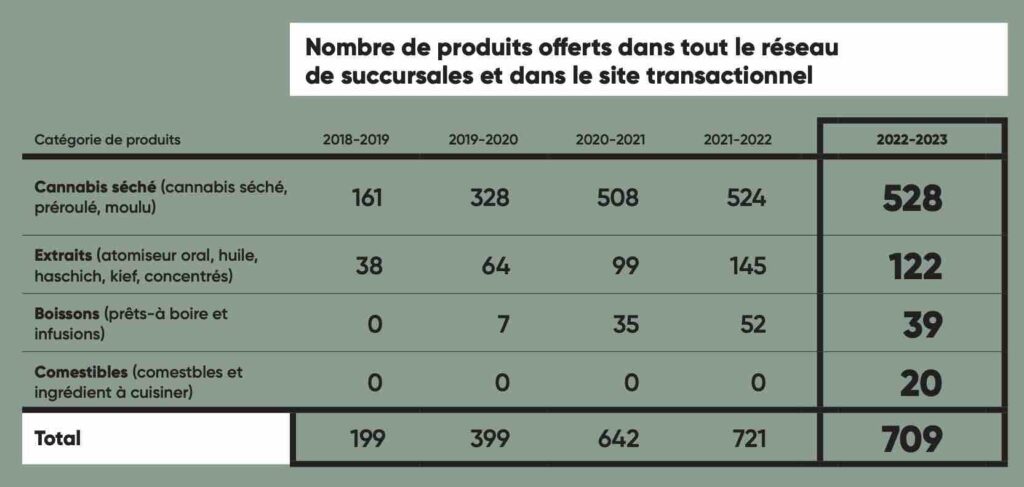
One of the challenges Farcy says the SQDC is trying to address is that many consumers are unaware of many of the products the store carries. Although Quebec has more restrictions on products than other provinces, such as no high potency extracts or vape pens, they have introduced kief, hash, and a handful of edibles for the first time.
He says the market plateauing is an expected development, and now the agency is focusing on better serving customers within the existing footprint rather than expanding it.
“It’s time now to reconsider the way we do things, and enhancing the network or the number of stores is not a winning strategy for the future,” Farcy tells StratCann. “Now that we have 98 stores, we need to make sure that we satisfy our customers more within our stores. We need to put more energy there.”
In addition to new products, the province has also expanded its delivery service. About 20% of the province can now have cannabis delivered within 90 minutes of ordering from the SQDC’s online store, and same-evening service is available for about half of the province—something he says was just “a dream” a year ago.
The inability to sell all the products that consumers want is another challenge, he admits, as is the prevalence of illicit online sites that consumers may not know are illegal. Although Farcy expects to see the agency make more inroads with consumers still buying from the illicit market by informing them of newer products and the variety of prices—from a low of around $3 a gram to higher quality products at nearly $20 a gram—capturing all of the market will not be possible.
“That’s the reason we cannot claim that we will capture 100% of the market in the next three years, because there are these products that would be illegal.”
“The other thing that is important is what is legal in the minds of customers,” he adds, referring to illicit online stores.
“Customers don’t necessarily understand that buying on a website outside of Quebec, by nature, is illegal. We can’t really blame them for not understanding, because we have not made enough information available around those grey zones. And illegal markets are very clever with their approach.”
“It’s really important that we do as much as we can to not keep this confusion alive.”
Still, he sees many opportunities the SQDC is already taking to refine that shopping experience and better educate customers about what is available. One example he gives is some new store designs that provide employees with a better chance to engage with customers on the floor rather than just behind the counter.
He acknowledges the next few years will be a harder fight than the first several years of legalization, but sees many opportunities for continued success.
SQDC annual report 2023
The Société québécoise du cannabis (SQDC) sold $601.9 million worth of cannabis in 2022 according to the agency’s most recent annual report.
This amounted to $94.9 million in revenue from sales for the fiscal year ended March 25, 2023. The SQDC also brought in an additional estimated $137.8 million in consumption tax and excise tax, for a total of $232.7 million to the Quebec government, which directs the funds to prevention and cannabis research.
Website sales were also down slightly, from $36.2 million in 2022 to $34.1 million at the end of March 2023.
The SQDC sources products from 48 active suppliers, 54 percent of which are based in Quebec. Forty-one percent of the total volume of cannabis sold in Quebec carries the Quebec Grown identifier, meaning it is mostly grown in Quebec.
Ten new branches of the SQDC opened in the 2022-2023 fiscal year.
A recent study funded by the federal government highlights the challenges associated with developing a cannabis breathalyzer. The research, conducted by National Institute of Standards and Technology (NIST) and Colorado Boulder University, demonstrates that determining recent marijuana use based on THC levels in breath is highly unreliable due to inconsistencies.
The study, published in the “Breath Research” Journal, involved 18 participants from Colorado who consumed retail marijuana with approximately 25% THC. Breath and blood samples were taken 15 minutes before and one hour after smoking marijuana, using a well-equipped white van conveniently parked outside their homes. The analysis was conducted in a laboratory setting, as NIST clarified that it is not currently working on a breathalyzer device. Instead, the agency concentrated on learning more about how to precisely measure THC and other related substances in a breath sample.
Only 8 of the 14 individuals who supplied breath samples before and after using marijuana showed the anticipated increase in THC levels. The remaining findings lacked clarity, with three after-use breath samples exhibiting no detectable THC, and the others exhibiting amounts that were comparable to or lower than the baseline.
In contrast, the study found that the level of THC in the blood, specifically measured through plasma, proved to be a more accurate indicator of recent marijuana use. Even though THC levels in blood demonstrated compliance with the study procedure and showed a considerable increase right after usage, THC levels in breath after an hour did not always surpass the baseline.
Tara Lovestead, the supervisory chemical engineer at NIST and coauthor of the report, expressed surprise at the similar range of THC levels in breath samples taken before and after marijuana use.
While the study’s small scale limits the statistical significance of the results, NIST and the authors emphasized the need for more research.
As cannabis legalization progresses in more states, entrepreneurs and scientists are striving to create THC field sobriety tests, such as breathalyzers. However, despite efforts from companies such as Hound Labs in Oakland, California, which anticipated deploying its device to regulators and law enforcement in 2016, widespread adoption of any marijuana field sobriety test has not yet been achieved.
The recent study received funding from a grant provided by the DOJ’s National Institute of Justice. The study team has also received an extra $1.5 million to carry out and expand the study. To provide more statistically meaningful results, the following phase will include 40 or more people and more breath samples.
The marijuana industry is still in flux, and much could change at the state and federal level regarding the way in which this substance is regulated. This is because policy often evolves in response to the emerging scientific data about something, and marijuana policy is no different. As society changes its perception towards marijuana, we are seeing many companies such as IGC Pharma Inc. (NYSE American: IGC) seeking to tap the medicinal qualities of cannabis by developing formulations for chronic pain and other indications from compounds extracted from the marijuana plant. These drugs could broaden the options that patients have in the coming years.
NOTE TO INVESTORS: The latest news and updates relating to IGC Pharma Inc. (NYSE American: IGC) are available in the company’s newsroom at https://cnw.fm/IGC
About CNW420
CNW420 spotlights the latest developments in the rapidly evolving cannabis industry through the release of two informative articles each business day. Our concise, informative content serves as a gateway for investors interested in the legalized cannabis sector and provides updates on how regulatory developments may impact financial markets. Articles are released each business day at 4:20 a.m. and 4:20 p.m. Eastern – our tribute to the time synonymous with cannabis culture. If marijuana and the burgeoning industry surrounding it are on your radar, CNW420 is for you! Check back daily to stay up-to-date on the latest milestones in the fast -changing world of cannabis.
To receive instant SMS alerts, text CANNABIS to 21000 (U.S. Mobile Phones Only)
Please see full terms of use and disclaimers on the CannabisNewsWire website applicable to all content provided by CNW420, wherever published or re-published: http://CNW.fm/Disclaimer
Do you have questions or are you interested in working with CNW420? Ask our Editor









Recent Comments