by Grow Up Conference | Jun 7, 2023 | Extraction Magazine, Media Partners
As the laws surrounding cannabis continue to evolve across the globe, interest in cultivating and harvesting the plant for both recreational and medicinal purposes is subsequently growing. As a result, there is a heightened interest in understanding the precise chemical makeup of cannabis, particularly in terms of growing plants indoors vs outdoors.
An expanding body of research continues to uncover the vast potential benefits that cannabis and its compounds have on the body and mind. Yet the environment that the plant is grown in could make a big difference in the final chemical composition and determine if the inflorescences or the cannabis-derived products could be used in the medical or recreational markets.
How Does The Environment Impact the Cannabis Chemical Profile?
The chemical profile of the cannabis plant, composed of cannabinoids, flavonoids, terpenoids, and sterols among other compounds, is affected by both the plant’s genetics and the growing environment. As such, the effects of various cannabis strains are associated with the differences and quantities of these metabolites.
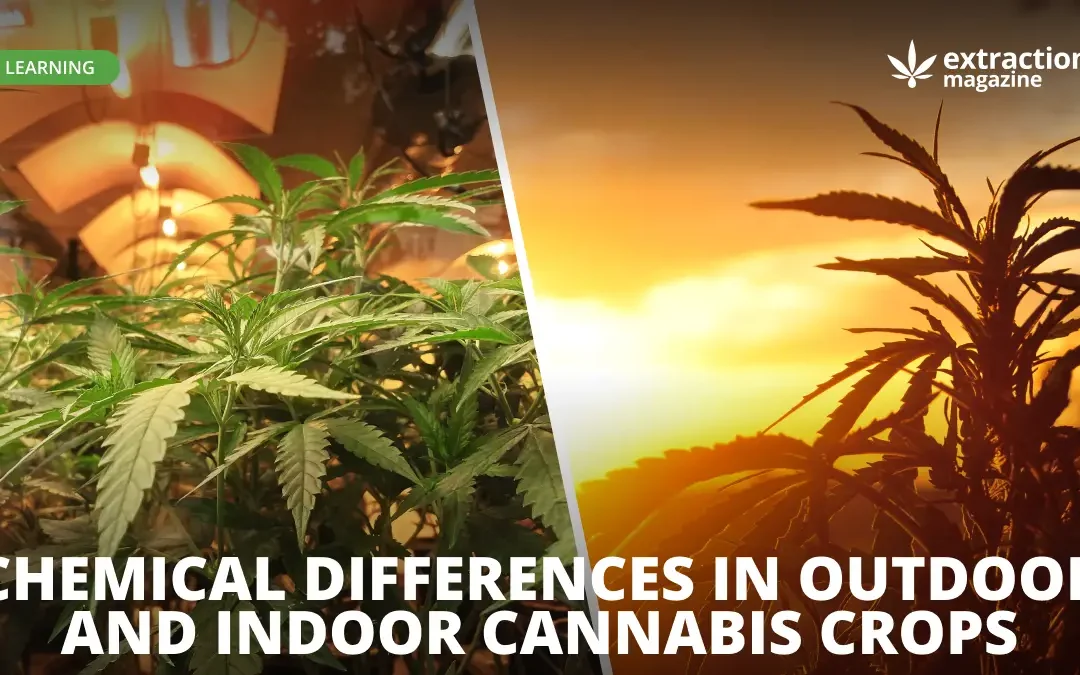
Cannabis can be grown outdoors like a traditional crop with full sunlight and other environmental factors. It can also be effectively grown and harvested indoors with the use of artificial lighting in a controlled environment. Information on how indoor vs outdoor growing factors affect the cannabis composition is limited.
A recent study was conducted in the effort to shed more light on the chemical differences between indoor and outdoor cannabis crops. [1] The cannabis plants used for the study were the same chemovar but grown in different settings.
The outdoor plants were grown in natural soil under full-spectrum natural light, while the indoor plants were grown in a nutrient-rich growth medium under artificial light in an optimized environment. Both sets of plants were grown in the same season to ensure the most accurate comparison.
Findings from the study showed significant differences between both sets of plants grown in different environments in terms of cannabinoid and terpene profiles. The relative concentration of metabolites in the plant is influenced by the environment the plants are grown in. More specifically, the type of lighting and growth medium significantly impacts the chemical make-up of cannabis flowers.
Environmental Factors Influence the Cannabis Chemical Composition
Cannabis plants grown indoors show a greater incidence of oxidation and degradation of cannabinoids. In contrast, the outdoor plants show more bioavailable cannabinoids.
Various environmental factors influence the final chemical composition of cannabis plants including:
- temperature;
- humidity;
- mineral nutrition;
- soil bacteria.
For instance, certain minerals like nitrogen may help to maximize inflorescence biomass production, while depleting levels of major cannabinoids, such as tetrahydrocannabinolic acid (THCA) and cannabidiolic acid (CBDA). Using fertilizer containing phosphorus may help to increase levels of cannabidiol (CBD), cannabinol (CBN), and cannabigerol (CBG), while reducing levels of tetrahydrocannabinol (THC).
The mentioned cannabinoids, along with many others, may be decarboxylated through lighting, heating, and humidity control.
More Details On Cannabis Growth Environments Should Be Offered To the Consumer
Most recent studies on cannabis have been done on indoor growth environments, with fewer studies conducted on outdoor cannabis crops. More studies should be conducted on outdoor crops to collect info related to the final chemical plant composition induced by different environmental factors.
Given this significant difference between outdoor-grown vs indoor-grown cannabis, it’s important that consumers are informed of the cultivation environment in order to decide the product more suitable for their needs. Often consumers are likely not getting all the necessary information about the compounds present in the cannabis inflorescences they are consuming.
As such, details surrounding the exact environment that cannabis is grown in should be made clear to the consumer, as it has a direct effect on the cannabis chemical profile. More studies should be done in order to understand the differences in terms of chemical composition and relative concentrations of cannabis plants in relation to the growing environment.
References:
- Zandkarimi, F., et al, “Comparison of the Cannabinoid and Terpene Profiles in Commercial Cannabis from Natural and Artificial Cultivation“, Molecules, January 2023, 28(2), 833.

by Grow Up Conference | Jun 7, 2023 | Media Partners, Oaksterdam University
by Grow Up Conference | Jun 7, 2023 | Media Partners, Psychedelic News Wire
Psychedelics are currently experiencing a renaissance that could leave them at the top of the psychiatric industry. Over the past couple of years, research has shown that natural and synthetic psychedelics show potential to treat symptoms of various mental health conditions.
Although treatments for conditions such as post-traumatic stress disorder, depression and anxiety already exist, those treatments often aren’t effective, and they rarely offer long-term relief. This means that people who are in desperate need of mental health treatment, such as military veterans, rarely receive the treatment they need and often end up dealing with their symptoms in other ways.
Congressional lawmakers are looking to change that by providing veterans plagued with mental disorders access to psychedelic treatments. Bipartisan lawmakers recently introduced a bill to invest millions of dollars into studying the medical potential of using psychedelics to treat specific medical conditions in active members of the military.
The resolution, which would create a $75 million fund to support psychedelic research for military personnel, was filed by Representative Dan Crenshaw and has 11 cosponsors. It would require the defense secretary to create a federal grant program to fund phase 2 clinical trials researching ibogaine, psilocybin, 5–MeO–DMT and MDMA. The trials would focus on the effectiveness of the psychedelics against conditions such as chronic traumatic encephalopathy, PTSD and traumatic brain injury.
In addition, the program would train clinicians on how to treat active members of the armed forces who have covered conditions with psychedelic treatments.
The psychedelic bill would direct $15 million to the Defense Department each year from 2024 to 2028 to fund the grant program. Surprisingly, researchers would be allowed to use grant funds to study psychedelics even if federal or military statutes classify the substances as controlled substances. This will undoubtedly go a long way toward removing the regulatory barriers that have held back psychedelic research for decades.
Nonprofit organizations, academic institutions, and state and federal agencies will be able to apply for the psychedelic grant funds.
If the bill is enacted, the defense secretary would have 180 days to provide Congress with a report detailing the clinics chosen for the grants, the number of armed forces members who took part in the trials and the findings. The defense secretary would also be required to submit such a report to Congress every 180 days after the first report.
Retired Navy Seal and Veterans Exploring Treatment Solutions CFO Henry Berkowitz said that measures which expand psychedelic research are crucial for former and current members of the armed forces.
With America’s military service members dealing with exceedingly poor mental health at high rates, we are in desperate need of treatments that are safe, effective and offer long-term relief. Startups such as atai Life Sciences N.V. (NASDAQ: ATAI) are executing R&D programs geared at bringing to market psychedelic-based treatments that will offer these patients the relief they need.
About PsychedelicNewsWire
PsychedelicNewsWire (PNW) is a specialized content distribution company that (1) aggregates and distributes news and information on the latest developments in all aspects and advances of psychedelics and their use, (2) creates PsychedelicNewsBreaks designed to quickly update investors on important industry news, (3) leverages a team of expert editors to enhance press releases for maximum impact, (4) assists companies with the management and optimization of social media across a range of platforms, and (5) delivers unparalleled corporate communication solutions. PNW stays abreast of the latest information and has established a reputation as the go to source for coverage of psychedelics, therapeutics and emerging market opportunities. Our team of seasoned journalists has a proven track record of helping both public and private companies gain traction with a wide audience of investors, consumers, media outlets and the general public by leveraging our expansive dissemination network of more than 5,000 key syndication outlets. PNW is committed to delivering improved visibility and brand recognition to companies operating in the emerging markets of psychedelics.
To receive instant SMS alerts, text “Groovy” to 844-397-5787 (U.S. Mobile Phones Only)
For more information please visit https://www.psychedelicnewswire.com
Please see full terms of use and disclaimers on the PsychedelicNewsWire website applicable to all content provided by PNW, wherever published or re-published: https://www.psychedelicnewswire.com/Disclaimer
Do you have questions or are you interested in working with PNW? Ask our Editor
PsychedelicNewsWire (PNW)
San Francisco, California
www.psychedelicnewswire.com
415.949.5050 Office
Editor@PsychedelicWire.com
PsychedelicNewsWire is part of the InvestorBrandNetwork.
by Grow Up Conference | Jun 7, 2023 | Media Partners, Oaksterdam University
Humans have perfected cannabis extraction methods and practices over thousands of years. Some of these traditional methods are still widely used, but 21st-century technology and commercial legalization have resulted in an extraction renaissance that is radically reshaping the way people consume cannabis.
Extractions result in various end products with different colors, textures, consistencies, flavors, and phytochemical profiles. Some extractions are niche and connoisseur products, and some are the base for finished products made with lower-quality flowers that produce higher profit margins.
To help consumers navigate extract types, prices, processes, characteristics, and the extraction method used to produce them, Oaksterdam University has created this downloadable infographic.

by Grow Up Conference | Jun 7, 2023 | Cannabis Prospect Magazine, Media Partners
by Grow Up Conference | Jun 7, 2023 | Cannabis Prospect Magazine, Media Partners
by Grow Up Conference | Jun 7, 2023 | Cannabis Prospect Magazine, Media Partners
by Grow Up Conference | Jun 7, 2023 | Cannabis Prospect Magazine, Media Partners
by Grow Up Conference | Jun 7, 2023 | Grow Opportunity, Media Partners
(Globe Newswire) Toronto — Dimensions has announced that Veterans Affairs Canada (VAC) has officially approved their ELEVATE for Veterans-Only Program as a VAC Interdisciplinary (IDC) inpatient program.
The Canadian company offers health and wellness retreat experiences with a therapeutic focus on mental health disorders affecting the central nervous system. Retreats will be conducted monthly at their flagship Dimensions Algonquin Highlands property, beginning this June 2023.
“Dimensions’ IDC designation by VAC signals a positive complement or alternative to traditional cognitive and talk therapies. It demonstrates the broader acceptance of group and individual somatic psychotherapy and provides the opportunity for treatment-resistant Veterans to explore the body, mind, and emotions with progressive evidence-based treatments.” — Donald Currie, RP, clinical director, Dimensions Algonquin Highlands
The program’s evidence-based approach includes a retreat supported by the latest developments in neuroscience and neurobiology, oriented towards mitigating the symptoms of Post-Traumatic Stress Disorder (PTSD), Post-Traumatic Stress Injury (PTSI), anxiety disorders, and depression.
According to Dimensions’ chief medical officer, DJ Cook MD, PhD, FRCS (C): “The Veteran population has unique healthcare needs with complex mental health disorders and injuries that traditional therapies can be ineffective in fully addressing. Dimensions recognizes that this next step in the evolution of mental health treatment for Veterans requires a collaborative therapeutic approach to healing with somatic therapy.”
ELEVATE for Veterans-Only Program is a holistic treatment model with a wellness plan individualized and optimized for Veterans across a timeline that includes an initial assessment, individual and group psychotherapy and preparation prior to a 10-day retreat. Post-discharge aftercare spans 42 weeks.
The delivery of care by Dimensions’ trauma-sensitive interdisciplinary team, is led by Donald Currie, Registered Psychotherapist (RP). The on-site retreat team of more than 20 experienced and licensed psychotherapists and clinicians upholds the role somatic therapy can play in helping people process trauma stored in the body and the nervous system.
The goal of the program is to improve outcomes in psychological functioning and well-being for the Veterans, as well as eliciting improvements in their pain experience. With the support of a lakeside setting in nature; psychotherapy; nutritious meals; daily breathwork; and bodywork practices, such as yoga, Qigong, and massage therapy, Veterans identify the sources and triggers of their mental-health and pain challenges. Through the various healing modalities, their central nervous system is reset, and stress, anxiety, and depression symptoms are reduced. Meals are created around guests’ retreat schedule and dietary specifications and preferences. The ingredients and preparations optimize gut health and brain health.
The clinical program and evidence-based treatments included in the ELEVATE for Veterans-Only Program were developed over three years, in conjunction with researchers and clinicians from Ontario’s Queen’s University. The process included a comprehensive review of proven healing modalities and best practices to aid Veterans in their healing journeys.
In the summer of 2022, Dimensions also identified a core group of Veterans who expressed the need for an effective therapy in a natural environment — and one that was cannabis tolerant, given many Veterans have an existing prescription for medical marijuana. Their insights helped ensure the relevancy of the current program.
Dimensions Algonquin Highlands is open to clients by clinical assessment only. The retreat’s main gathering place, Maple Lodge, includes a dining room, lounge, nine treatment rooms, and a float room. On site, there is also a ceremony dome, a yoga/multipurpose room, and various wellness and outdoor features such as forest trails, a yoga deck, and forest installations.
Seventeen private cabin suites with private decks have been custom designed by internationally renowned creative studio and hospitality design experts DesignAgency, to provide guests with a calming sanctuary to relax, prepare and reflect, during their healing retreat. Dimensions Algonquin Highlands, located at 1218 Canopy Lane, can be reached from Toronto, Ontario, in under three hours by car, and one hour by private airplane to the nearby Stanhope Municipal Airport (CND4).
by Grow Up Conference | Jun 7, 2023 | Grow Opportunity, Media Partners
By Lindsay Whitehurst
The past drug use that Prince Harry detailed in his explosive memoir should spark the release of his immigration paperwork, a conservative American think tank argued in a Washington court Tuesday as they appealed to a judge for a quicker response a records request the U.S. government has so far deemed private.
The hearing played out, coincidently, as the Duke of Sussex himself testified London in another lawsuit he filed against British newspapers. In Washington, U.S. District Judge Carl Nichols told the Heritage Foundation and the Department of Homeland Security to work on the speed of the response, and he would rule if they could not reach an agreement on their own.
Harry moved to Southern California with his wife Meghan Markle and their young family in 2020 after they left royal life and embarked on new projects, including the release of his memoir “Spare” in January.
The book’s myriad revelations included an exploration of Harry’s grief after the death of his mother, Princess Diana, disputes with his brother William and his past drug use. Harry said he took cocaine several times starting around age 17, in order “to feel. To be different.” He also acknowledged using cannabis and psychedelic mushrooms.
The U.S. routinely asks about drug use on its visa applications, and it has been linked to travel headaches for celebrities, including chef Nigella Lawson, singer Amy Winehouse, and model Kate Moss. But acknowledgement of past drug use doesn’t necessarily bar people from entering or staying in the country.
With that history in mind, the conservative Heritage Foundation sent a public-information request to the Department of Homeland Security for Prince Harry’s immigration records.
They argue there is “intense public interest” in whether Harry got special treatment during the application process. The politically conservative group also linked those questions to wider immigration issues in the U.S., including at the southern border with Mexico.
“What this case is truly about is DHS,” said Samuel Dewey, a lawyer for the Heritage Foundation.
The request has largely been denied since the group doesn’t have Prince Harry’s permission to get the private information.
“A person’s visa status is confidential,” said John Bardo, an attorney for the Department of Homeland Security.
The agency’s policy does allow the release of information about issues of public interest, but the agency argued that media coverage of how Harry’s drug use connects to his visa status in the U.S. hasn’t been widespread among mainstream American publications.
The questions that have been raised, meanwhile, aren’t the kind of weighty queries about possible government misdeeds that warrant the fast processing the Heritage Foundation is asking for, federal attorneys argued.
A representative for Harry did not immediately respond to an email message seeking comment.
While two of the three agencies involved have denied the request, Department of Homeland Security headquarters hasn’t formally responded and is fighting the foundation’s push to act quickly. Nichols expressed frustration at being asked to decide the narrow question whether to order a fast response, but said he would rule if the two sides couldn’t come to an agreement on their own within a week.
Privacy is also at the center of the lawsuit Harry filed against the publisher of the Daily Mirror that was the subject of his testimony in London on Tuesday.
That suit is playing out thousands of miles away over 33 articles published between 1996 and 2011. He says they were based on phone hacking or other illegal snooping methods. Harry testified that Britain’s tabloid press had a “destructive” role throughout his life, but also faced sharp questioning from a newspaper’s lawyer about whether he could remember reading the articles.

Recent Comments